
More than 50,000 migrants entered the Spanish territory in one of Europe’s biggest border crises in recent years, with at least 57 people reported dead and thousands later returning voluntarily.
Tens of thousands of migrants who crossed into Spain’s North African enclave of Ceuta from Morocco have begun returning voluntarily, a day after one of the largest mass migration episodes in Europe in recent years left at least 57 people dead and triggered a major humanitarian and security crisis.
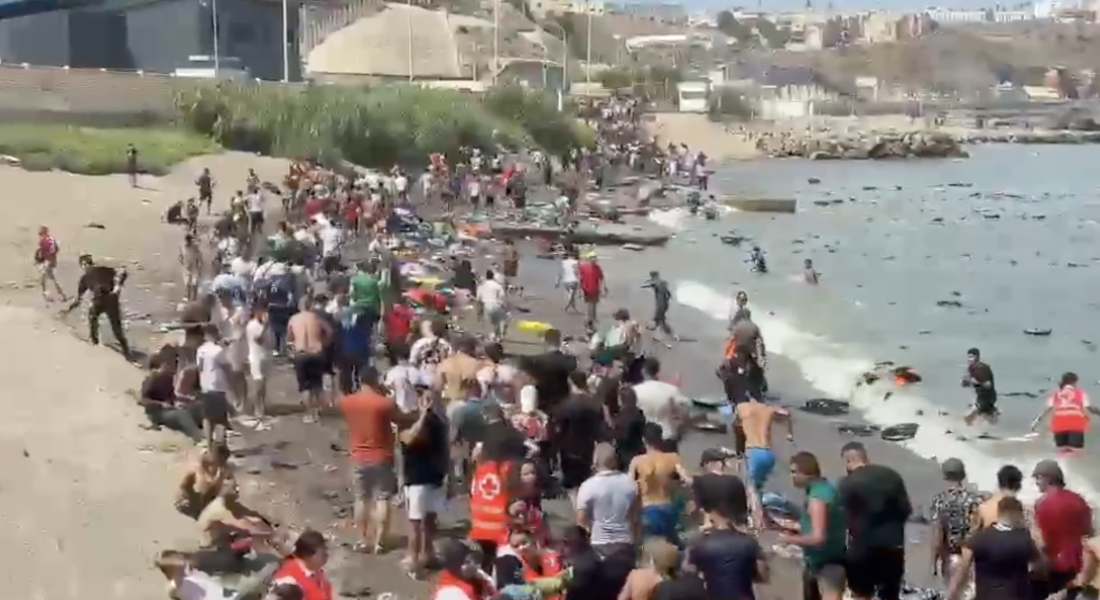
According to media reports, more than 50,000 people entered Ceuta by land and sea between Thursday and Friday, with many swimming long distances while others attempted to breach border barriers. The unprecedented influx overwhelmed local authorities and prompted Spain to deploy additional police and military personnel to restore order.
Reports said around 45,000 of the estimated 60,000 migrants who crossed into Ceuta returned to Morocco within hours. Hundreds were seen making their way back through official border checkpoints and gaps in the border fence after spending the night on the streets of the enclave.
Many migrants reportedly cited the lack of food, shelter and basic facilities inside Ceuta as the main reason for returning. Some claimed they had been forced out by Spanish security forces after entering the enclave.
The humanitarian crisis unfolded as Moroccan security forces used batons, tear gas and water cannons to prevent more people from crossing into the Spanish territory. On the Spanish side, military vehicles were deployed along the border while dozens of migrants remained gathered near the frontier, unable to cross.
Media reports said those who lost their lives included migrants who drowned while attempting the sea crossing, while others reportedly died in a stampede during the chaotic influx.
The sudden arrival of such a large number of migrants—equivalent to nearly 70 per cent of Ceuta’s population—prompted authorities to seek emergency police and military reinforcement. Residents expressed concern as thousands of mostly young men moved through the enclave’s streets amid heightened security.
According to reports, Ceuta’s authorities linked the surge in migration to a recent ruling by Spain’s Supreme Court, which held that migrants intercepted at sea could not be immediately returned under the enclave’s long-standing “border rejection” system. The ruling, however, does not apply to migrants entering by land.
Spanish Prime Minister Pedro Sánchez visited Ceuta on Friday and described the mass crossing as a violation of Spain’s territorial integrity. He blamed human trafficking networks for encouraging dangerous migration attempts that had resulted in multiple deaths.
Some reports also suggested that Spain’s recent migration policies, including measures to regularise undocumented migrants already living in the country by granting residency and work permits, may have influenced the increased attempts to reach Spanish territory.
The crisis also drew international political attention. US President Donald Trump described the situation as a “catastrophe” and likened it to an invasion during a Cabinet meeting, while Italy announced the temporary suspension of the Schengen border-free arrangements with Spain and said it would strengthen checks along its land border with France to prevent secondary migration.
Ceuta, along with Melilla, is one of Spain’s two autonomous enclaves on Morocco’s northern coast and represents the European Union’s only land border with Africa, making it a frequent flashpoint for irregular migration.