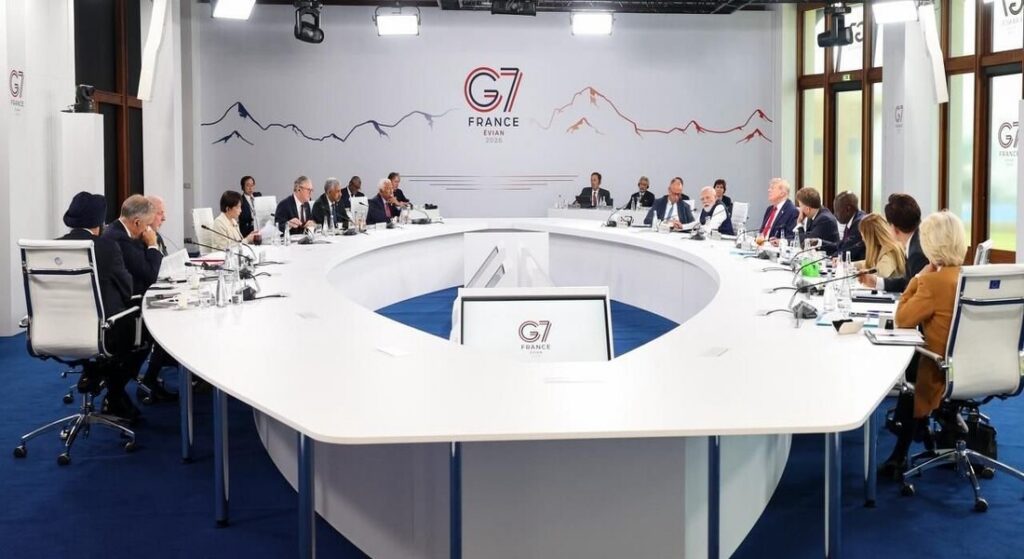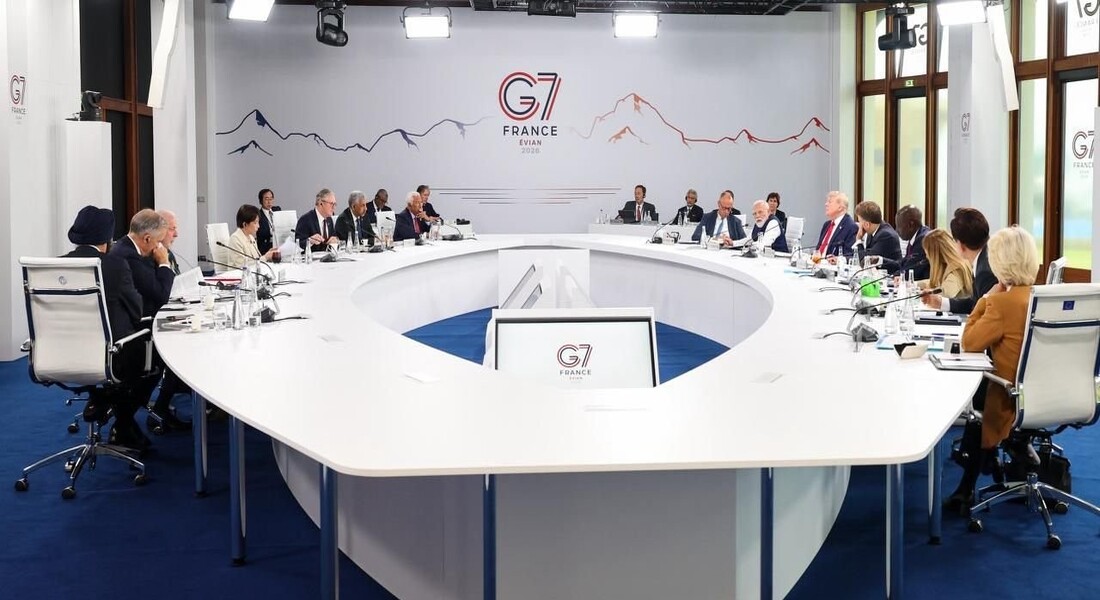

NEW DELHI: Prime Minister Narendra Modi on Tuesday called for rebuilding international solidarity through trust, transparency, and equal partnerships while holding a series of bilateral meetings with leaders from Canada, the UAE, and the UK on the sidelines of the G7 Summit in Evian, France.
Addressing the Outreach Session on “Forging New Partnerships and Rebuilding International Solidarity”, Modi said that in an interconnected world, energy, food, health, cyber, and economic security are closely linked, making international partnerships essential for global progress and prosperity.
He noted that trade and technology were increasingly being misused for narrow interests, creating a trust deficit in international relations. Referring to lessons from the COVID-19 pandemic, the PM urged nations to strengthen trust and transparency in global cooperation.
Highlighting India’s approach to international engagement, Modi said the country continues to follow the principle of “humanity first” through initiatives such as the International Solar Alliance, Coalition for Disaster Resilient Infrastructure, Global Biofuel Alliance, Mission LiFE, and the Ek Ped Maa Ke Naam campaign.
He also pointed to India’s role as a first responder during natural disasters in countries including Sri Lanka, Afghanistan, Mozambique, and Jamaica, according to an official statement.
The PM said India’s development model, guided by the principle of “Sarv Jan Hitaye, Sarv Jan Sukhaye”, has helped advance financial inclusion, health security, digital identity, technology-led empowerment, and women-led development.
Calling for a shift beyond the traditional donor-recipient framework, Modi said international partnerships should be based on solidarity and equal ownership. He added that respect for international law, along with dialogue and diplomacy, remains crucial for achieving peace and stability.
On the sidelines of the summit, Modi met Canadian Prime Minister Mark Carney. The two leaders welcomed the positive momentum in India-Canada relations and reviewed progress made since Carney’s visit to India in March this year.
The leaders discussed bilateral economic cooperation, including commercial arrangements related to LNG, LPG, and metallurgical coal. They also noted progress in negotiations for a Comprehensive Economic Partnership Agreement and reaffirmed their goal of concluding the talks in 2026.
Modi also held talks with UAE President Mohamed bin Zayed Al Nahyan, marking their third meeting this year. The two leaders reviewed cooperation in technology, trade, investment, energy, and defence under the India-UAE Comprehensive Strategic Partnership.
They exchanged views on regional and global developments, with Modi stressing the importance of dialogue, diplomacy, and respect for international law, sovereignty, and territorial integrity in ensuring peace and stability in West Asia. Both sides also called for free, safe, and unimpeded navigation and trade through the Strait of Hormuz. Modi extended an invitation to the UAE President to attend the upcoming BRICS Summit in India.
In a separate bilateral meeting, Modi met his UK counterpart, Keir Starmer. The two leaders reviewed progress under the India-UK Vision 2035 partnership covering trade, defence, climate action, technology, innovation, and education.
They expressed hope for the early implementation of the Comprehensive Economic and Trade Agreement and welcomed recent developments in educational cooperation, including plans by the University of Liverpool to establish a campus in Bengaluru and initiatives involving the University of York and the University of Bristol in Mumbai.