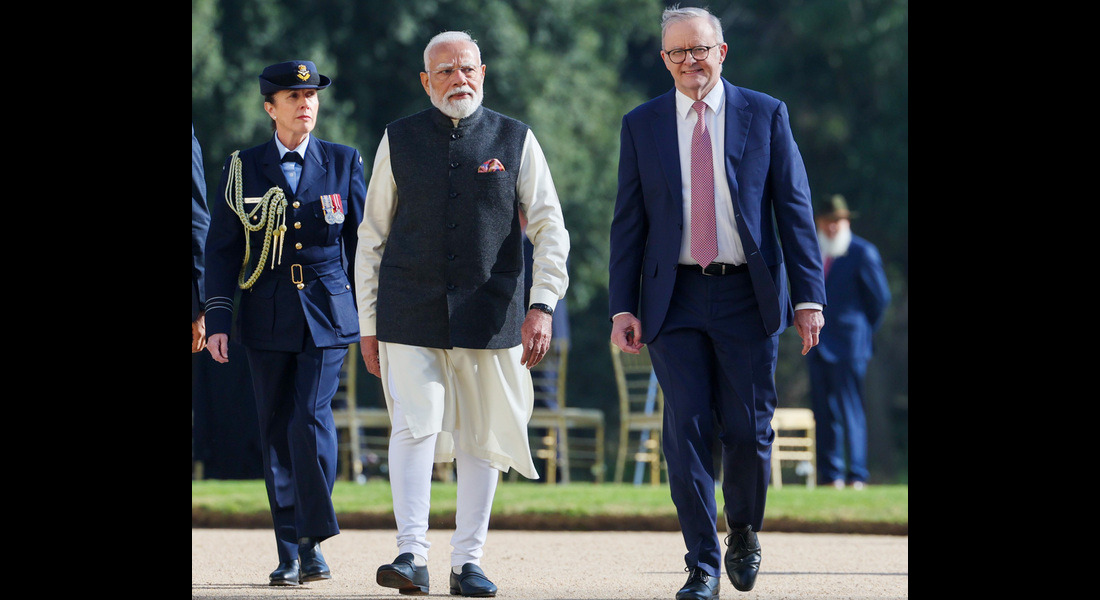

Leaders unveil ambitious roadmap spanning defence, clean energy, critical minerals, education and technology, while reaffirming commitment to a free, open and rules-based Indo-Pacific.
New Delhi: India and Australia on Thursday significantly expanded their Comprehensive Strategic Partnership by unveiling a wide-ranging agenda covering defence, energy security, trade, critical minerals, advanced technology, education and maritime cooperation, as Prime Minister Narendra Modi and his Australian counterpart Anthony Albanese held the Third India-Australia Annual Summit in Melbourne.
The two leaders adopted a Joint Declaration on Defence and Security Cooperation and a Joint Statement on Energy Security, reaffirming their shared commitment to building a free, open, stable and prosperous Indo-Pacific while strengthening economic resilience amid growing geopolitical uncertainty and global supply chain disruptions.
Addressing business leaders at the India-Australia CEO Forum and Economic Roadmap Business Reception, Prime Minister Modi described India and Australia as “natural and trusted partners” at a time when the world is facing uncertainty, energy challenges and disruptions to global supply chains. He said the two governments had laid a strong foundation through the Economic Cooperation and Trade Agreement (ECTA) and were now working towards a Comprehensive Economic Cooperation Agreement (CECA) to unlock greater investment and innovation.
Highlighting the rapid growth in bilateral commerce, Modi noted that Indian exports to Australia had doubled since ECTA came into force in 2022. He invited Australian businesses to expand investments in India’s clean energy, infrastructure, manufacturing and emerging technology sectors, saying both countries had created “a new runway” for economic cooperation.
The Prime Minister outlined India’s ambitious energy transition plans, including achieving 500 GW of renewable energy capacity by 2030 and Net Zero emissions by 2070. He also highlighted recent reforms opening India’s nuclear energy sector to private participation, saying Australia’s vast uranium reserves could play an important role in supporting India’s target of generating 100 GW of nuclear power by 2047.
Reflecting this growing energy partnership, the two countries finalised the administrative arrangements required for the export of Australian uranium to India for exclusively peaceful purposes under International Atomic Energy Agency safeguards. The two sides also pledged to strengthen cooperation in liquefied natural gas, coal, liquid fuels, renewable energy, low-carbon fuels and resilient regional energy supply chains. Australia also acknowledged India’s Global Biofuels Alliance initiative as both nations committed to accelerating the clean energy transition.
Defence and security emerged as another key pillar of the summit. The Joint Declaration commits both countries to deepen military interoperability, expand joint exercises, strengthen maritime cooperation through an India-Australia Maritime Security Collaboration Roadmap, increase defence industry collaboration and enhance information sharing on terrorism, cyber security and emerging technologies. The leaders also announced an Annual Defence Ministers’ Dialogue to further institutionalise strategic engagement.
The summit also focused on strengthening cooperation in critical minerals, advanced manufacturing, artificial intelligence, semiconductors, quantum technologies, cyber security and defence innovation. Both countries agreed to develop more resilient supply chains while encouraging greater collaboration between industry, research institutions and governments.
Education and people-to-people ties also received fresh momentum. The leaders welcomed the expansion of Australian university campuses in India, including new approvals for Flinders University in Bengaluru and Victoria University in Gurugram. They also announced the establishment of a National Centre of Excellence for Skilling in Mining at Bhubaneswar in collaboration with the Government of Western Australia.
The two Prime Ministers reaffirmed support for regional institutions such as ASEAN, the Quad, the Indian Ocean Rim Association and the Pacific Islands Forum. They expressed concern over escalating tensions in the Middle East, called for restraint and uninterrupted global energy supplies, reiterated support for peaceful resolution of international conflicts through dialogue, and strongly condemned terrorism in all its forms, including the recent attacks in Pahalgam and Bondi Beach. Australia also reiterated its support for India’s candidature for a permanent seat in a reformed United Nations Security Council.
The summit concluded with both leaders expressing confidence that the next phase of the India-Australia Comprehensive Strategic Partnership would strengthen regional security, deepen economic integration and contribute to a stable, rules-based Indo-Pacific.