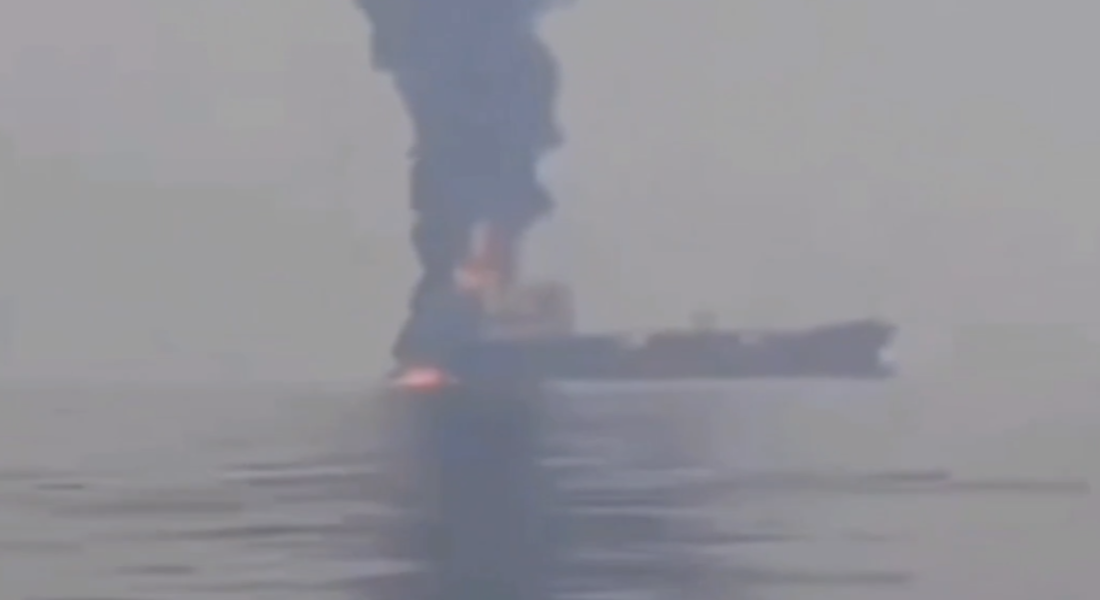

New Delhi: An India-flagged cargo vessel sank in the Red Sea off Yemen’s western coast after coming under projectile attack, with all 14 crew members, including 13 Indian sailors, rescued safely by Yemeni forces, even as New Delhi strongly condemned the assault and called for an immediate end to attacks on commercial shipping.
The vessel, MSV Faize Noore Oliya, was reportedly attacked around 13 nautical miles south of the Houthi-controlled port city of Hodeidah on Tuesday. The impact caused the cargo vessel to overturn and sink. The crew comprised 13 Indian nationals and one Yemeni sailor.
According to media reports, Yemen’s National Resistance Force, also known as the Guards of the Republic, said its coast guard and naval units carried out a joint rescue operation. All 14 crew members were rescued and provided medical assistance before being taken to the Port of Mokha.
India condemned what it described as an “unprovoked” attack on an unarmed commercial vessel. Union Ports, Shipping and Waterways Minister Sarbananda Sonowal said he had directed the Director General Maritime Administration (DGMA) to coordinate with all concerned agencies to ensure the safety of Indian seafarers operating in the region and extend all necessary assistance to the rescued crew.
“India strongly condemns this unprovoked attack on the defenseless mechanised sailing vessel. The safety of our people is our supreme priority,” Sonowal said, adding that all 14 seafarers had been rescued safely by the Yemeni Coast Guard.
Indian MSV Faize Noore Oliya has been hit by a projectile near Yemeni waters, causing the vessel to capsize and sink.
— Sarbananda Sonowal (@sarbanandsonwal) August 4, 2026
India strongly condemns this unprovoked attack on the defenseless mechanised sailing vessel. The safety of our people is our supreme priority & I am relieved to…
The Ministry of External Affairs said the Indian Embassy in Riyadh was closely monitoring the situation and coordinating with Yemeni authorities to ensure the welfare and security of the crew. It also described the continuing attacks on commercial shipping in the region as “deeply worrisome” and urged that free and unimpeded navigation through international waterways be restored in accordance with international law.
The latest incident comes amid growing security concerns in the Red Sea and surrounding maritime routes, where missile and drone attacks on commercial vessels have intensified in recent months. Last month, the Iran-backed Houthi movement announced a naval blockade against Saudi Arabia, escalating tensions and raising concerns over disruptions to global trade and energy supplies.
The Bab el-Mandeb Strait, located at the entrance to the Red Sea and linking it with the Gulf of Aden and the Indian Ocean, remains one of the world’s busiest shipping corridors and has increasingly become a flashpoint in the regional conflict.
Meanwhile, diplomatic efforts are continuing to ease tensions in another critical maritime chokepoint, the Strait of Hormuz.
According to media reports, talks mediated by Oman between Iran and international stakeholders have made progress on establishing secure shipping lanes through the strategic waterway. US Secretary of State Marco Rubio said negotiations had advanced, although no final agreement had yet been reached, while US Treasury Secretary Scott Bessent expressed hope that a deal could be concluded soon.
Iran’s Foreign Ministry also described the discussions with Oman as “positive”, saying they were focused on ensuring safe inbound and outbound navigation through the Strait of Hormuz.
US President Donald Trump also claimed that Washington was engaged in “very good discussions” with Iran, despite repeated denials from Tehran regarding direct negotiations. Iranian state media, meanwhile, reported that discussions were aimed at creating a new maritime corridor through the Strait of Hormuz to facilitate safe commercial navigation while protecting Iran’s interests as a coastal state.
The developments come as governments and the global shipping industry remain on high alert over security risks in two of the world’s most strategically important maritime trade routes, with concerns that continued attacks could further disrupt international commerce and endanger civilian seafarers.