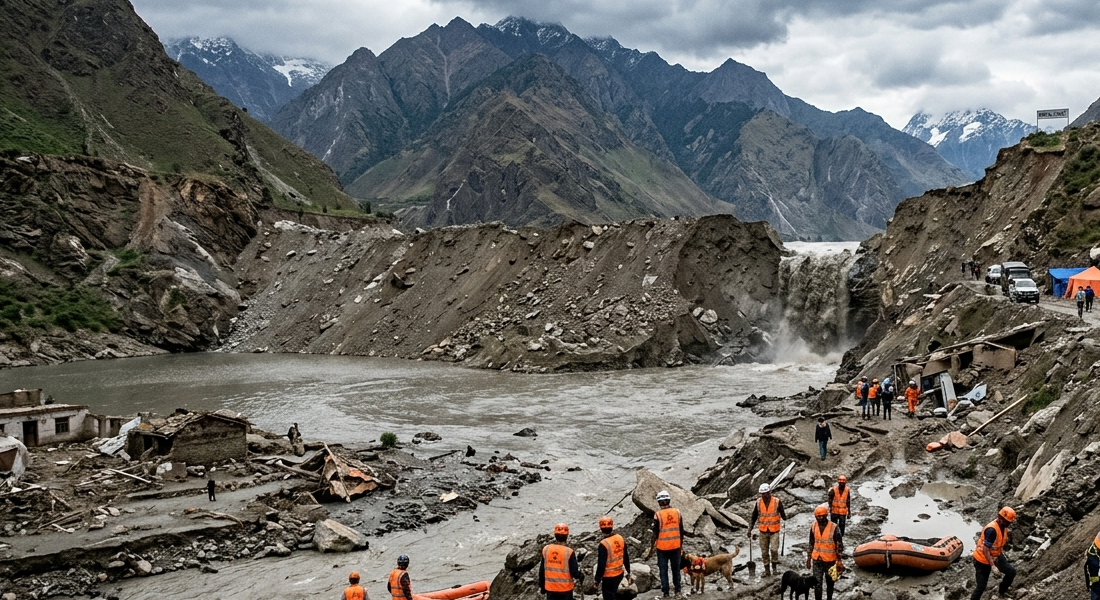

New Delhi: Rescue operations along the Nepal-Tibet border are facing a fresh challenge as rising water trapped behind massive debris threatens to trigger another flood.
The warning comes as authorities continue efforts to locate 1,468 people who remain missing after flash floods and landslides devastated the Himalayan region.
Among those unaccounted for are 290 Indian nationals, the Ministry of External Affairs said. So far, 84 Indians have been rescued, while efforts are continuing to trace those whose whereabouts remain unknown.
The disaster has claimed at least 392 lives on both sides of the border. Nepal has recorded 389 deaths, while China has reported three deaths in Tibet.
The scale of the destruction has made the search operation difficult. Floodwaters carrying ice, rocks, mud and debris swept through villages and destroyed homes, bridges and roads along a route linking Kathmandu with Lhasa, according to reports.
The region is also a major route for trekkers and pilgrims, including Indians travelling towards Mount Kailash and Mansarovar. Nepal has reported 910 people missing, including at least 517 foreigners. China has reported 558 missing, of whom 260 are foreigners.
Authorities are now closely monitoring lakes created by debris blocking Himalayan rivers.
In Nepal, a lake formed after the Bhotekoshi River was blocked by debris is continuing to rise, raising fears that the water could break through the obstruction.
China has warned of a similar risk. Around three million cubic metres of water could enter a dammed lake over the next three days. Chinese state media has reported a high risk of a breach, with peak flow expected around September 1.
The disaster was triggered by a glacier collapse that sent enormous quantities of rock, ice, mud and debris downstream.
An initial theory suggested that an earthquake may have caused the collapse. The US Geological Survey, however, said the magnitude 4.4 seismic event recorded in the area was generated by the collapse itself and the subsequent debris flow.
Experts have warned that the danger has not passed. Qianggong Zhang of the International Centre for Integrated Mountain Development said another flood could be imminent.
For rescue teams, the priority is now twofold: reaching people who may still be trapped or missing while preparing for a potentially dangerous new surge of water.