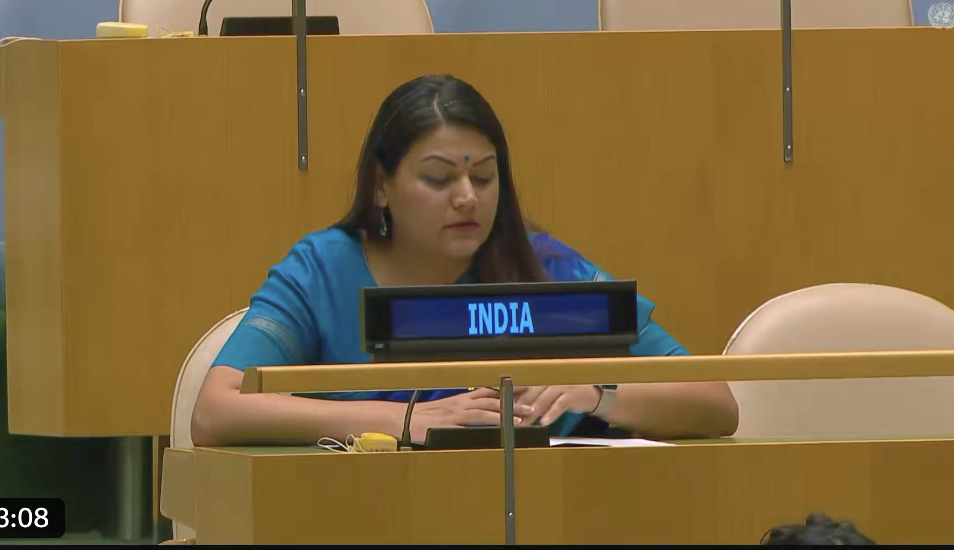

Petal Ghelot , First Secretary in India’s Permanent Mission to the UN, strongly rejects Pakistan PM Shehbaz Sharif’s UNGA remarks, while S Jaishankar responds sharply to a Pakistani journalist over allegations of terrorism
New Delhi: India has strongly rejected Pakistan Prime Minister Shehbaz Sharif’s remarks at the United Nations General Assembly, with New Delhi accusing Islamabad of supporting cross-border terrorism and reiterating that India will exercise its right to defend itself against terrorist attacks.
Exercising India’s Right of Reply after Sharif’s address, Petal Gahlot, First Secretary at India’s Permanent Mission to the UN, on Saturday rejected Pakistan’s remarks on Jammu and Kashmir and criticised what she described as Islamabad’s record on terrorism, democratic rights and treatment of minorities.
“At the heart of the issue is the long-standing practice of cross-border terrorism by Pakistan,” Gahlot said, adding that India had demonstrated that terrorists would have “nowhere to run and nowhere to hide”. She warned that terrorism from Pakistan “will have consequences”. The remarks were made in response to Sharif’s references to Kashmir and other issues involving India.
#IndiaAtUN
— India at UN, NY (@IndiaUNNewYork) September 26, 2026
Watch: First Secretary @petal_gahlot exercises 🇮🇳’s Right of Reply at #UNGA81. @MEAIndia @IndianDiplomacy @UN @PMOIndia @DDNewslive @airnewsalerts pic.twitter.com/MEW1n7WIJW
Gahlot also challenged Pakistan’s presentation of itself as a defender of democratic rights and human values, alleging that the country’s military establishment continues to exercise decisive political influence. She referred to Pakistan’s 27th Constitutional Amendment and alleged that it reflected the continuing influence of the country’s military leadership.
The Indian diplomat also invoked the presence of al-Qaeda founder Osama bin Laden in Abbottabad, near Pakistan’s premier military academy, while questioning Islamabad’s record on counter-terrorism. She further criticised Pakistan over its treatment of religious minorities and referred to its blasphemy laws.
India also rejected Pakistan’s position on Jammu and Kashmir, reiterating its stand that Jammu and Kashmir is an integral part of the country. New Delhi instead raised the issue of Pakistan-occupied Jammu and Kashmir. Sharif had also referred to the Indus Waters Treaty and India’s Operation Sindoor during his UNGA address.
The exchange at the UN came amid a broader escalation in rhetoric between the two countries at the 81st session of the UN General Assembly. India’s response followed Sharif’s address during the General Debate, which is being held from September 22 to 28 under the theme “Restoring trust, managing transformation: a United Nations that delivers for all”.
Separately, External Affairs Minister S Jaishankar was involved in another sharp exchange with a Pakistani journalist during a press interaction in New York on Friday.
Jaishankar was addressing reporters alongside Liberia’s Foreign Minister Sara Beysolow Nyanti in connection with the launch of the Group of Friends on Safety and Security of Shipping and Seafarers when a Pakistani journalist asked when the Indian government would stop “sponsoring terrorism in Pakistan”.
Jaishankar responded: “A terrorist country is asking me that question. Come on.” India’s Permanent Representative to the UN, Harish Parvathaneni, then told the journalist that he had heard the minister’s response.
The briefing was linked to the new India-Liberia maritime security initiative, which seeks to draw international attention to threats facing commercial shipping and seafarers. Jaishankar said attacks on commercial vessels and seafarers in the Gulf, Red Sea and surrounding waters had become a serious concern.
The latest exchanges come against the backdrop of continuing tensions between India and Pakistan over terrorism and security. India has repeatedly called on Pakistan to take what it describes as credible action against cross-border terrorism. New Delhi has also cited the April 2025 Pahalgam terror attack, in which 26 people were killed, as the trigger for Operation Sindoor.
India has also raised the issue of terrorist financing and sought international action against organisations and individuals it says operate from or have found shelter in Pakistan. Pakistan has rejected Indian allegations and has itself accused India of supporting militant activity against it.
The two sides continue to present sharply contrasting positions on terrorism, Jammu and Kashmir and regional security, with the latest exchanges at the UNGA adding to the diplomatic confrontation between the neighbouring countries.