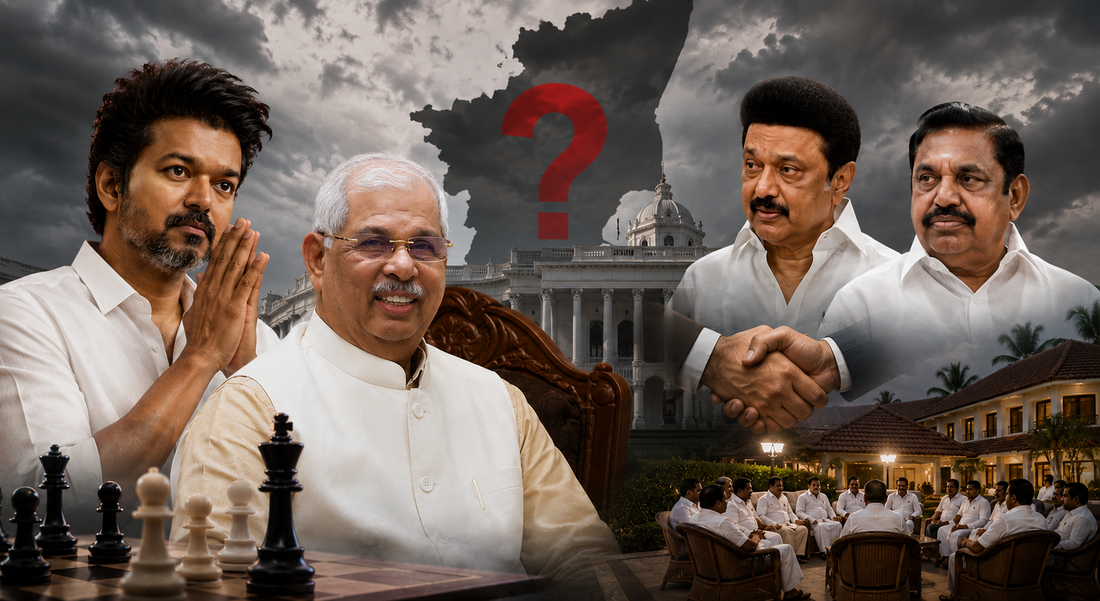

New Delhi: Tamil Nadu is witnessing intense political uncertainty days after actor-turned-politician Vijay led Tamilaga Vettri Kazhagam (TVK) to a stunning electoral debut, as rival parties explore possible realignments that could dramatically reshape the state’s political landscape.
Despite emerging as the single-largest party with 108 seats in the 234-member Assembly, TVK remains short of the majority mark of 118. While the Indian National Congress has extended support to the party, the combined numbers still fall short of forming a stable government.
The uncertainty deepened after Governor Rajendra Vishwanath Arlekar reportedly sought greater clarity on TVK’s support base before allowing the party to stake claim to form the government. Vijay met the Governor for the second time in three days on Thursday amid ongoing efforts to secure backing from smaller parties and independents.
According to reports, TVK has approached parties such as the Viduthalai Chiruthaigal Katchi (VCK), CPI and CPI(M) seeking support, but negotiations are still underway.
The delay in government formation has triggered speculation about possible political realignments, including a potential understanding between long-time Dravidian rivals—the Dravida Munnetra Kazhagam (DMK) and the All India Anna Dravida Munnetra Kazhagam (AIADMK).
According to NDTV, sections within both parties are exploring options to prevent Vijay’s rapid rise from translating into political power. The report, citing sources, claimed that some leaders within the DMK fear Vijay could recreate the kind of mass political appeal once enjoyed by former Chief Minister M. G. Ramachandran, who dominated Tamil Nadu politics for years.
The AIADMK, meanwhile, is also facing pressure after a series of electoral setbacks since the death of former Chief Minister J. Jayalalithaa. Reports suggest some within the party may be open to tactical arrangements to retain political relevance.
Don't Betray the Mandate, Don't Manipulate! pic.twitter.com/tuwoTqsiDg
— Tamil Nadu Congress Committee (@INCTamilNadu) May 8, 2026
Amid the fast-changing developments, more than 40 AIADMK MLAs are currently staying at a private resort in Puducherry, where party general secretary Edappadi K. Palaniswami held discussions with newly elected legislators.
The Tamil Nadu Congress Committee has accused the Governor and the Bharatiya Janata Party of attempting to deny TVK a “rightful democratic opportunity” to form the government. In a post on X, the party stated: “Don’t betray the mandate. Don’t manipulate.”
The developments also drew sharp reactions from Left parties, which questioned the Governor’s handling of the government formation process.
D. Raja, national secretary of the Communist Party of India, accused the Governor of playing a “dubious role” and argued that the issue of majority should be settled on the Assembly floor rather than at Raj Bhavan.
“The question of majority must be tested on the floor of the House and not in the halls of Raj Bhavan,” Raja said in a post on X.
He also cautioned against what he described as a “selective interpretation of constitutional norms”, adding, “The BJP should not be allowed to spread its tentacles in Tamil Nadu through the misuse of the office of the governor.”
M. A. Baby, general secretary of the Communist Party of India (Marxist), referred to the 1996 precedent when former Prime Minister Atal Bihari Vajpayee was invited to form the government despite lacking a post-poll majority.
“In such a situation, the established convention has been that the leader of the single largest party should be invited to form the government, take oath, and be given a reasonable period to prove majority on the floor of the House,” Baby told media, asserting that the Governor was both “duty-bound and convention-bound” to follow the same principle in Tamil Nadu.
Senior lawyer and former Solicitor General Harish Salve, however, told NDTV that the Governor was within his constitutional discretion to seek evidence of majority support before inviting a party to form the government.
Meanwhile, reports suggest TVK has warned that all its 108 MLAs could resign if rival parties attempt to form a government through post-poll arrangements without respecting the mandate received by the party.
The evolving political situation has created one of Tamil Nadu’s most unpredictable post-election scenarios in decades. What initially appeared to be a historic breakthrough for Vijay and TVK has now turned into a high-stakes contest involving constitutional procedures, coalition arithmetic and shifting political equations.
With negotiations continuing behind closed doors, the coming days are expected to determine whether Tamil Nadu witnesses a new political era under TVK or an unexpected realignment among established Dravidian forces.