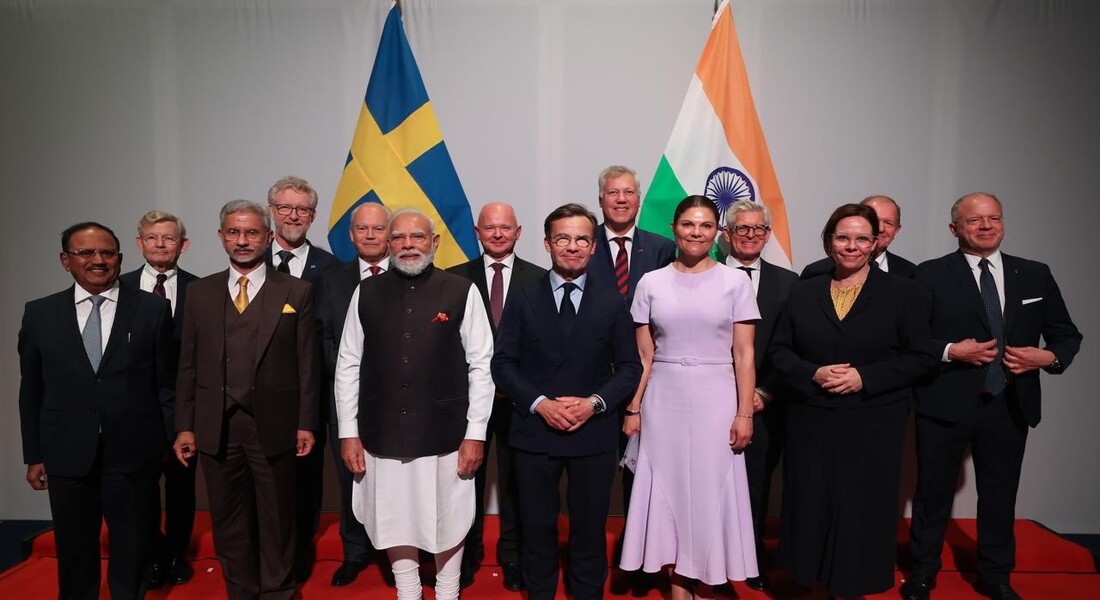

New Delhi: Prime Minister Narendra Modi used his visit to Sweden to position India as Europe’s long-term economic and strategic partner amid shifting global trade and security dynamics. During high-level engagements in Gothenburg, India and Sweden agreed to elevate bilateral ties to a Strategic Partnership, while India also intensified its outreach to leading European industries.
Addressing the European Round Table for Industry, Modi stressed the need for trusted partnerships amid global uncertainty. The interaction brought together Swedish Prime Minister Ulf Kristersson, European Commission President Ursula von der Leyen, senior industry executives, and representatives from major Indian and European companies, according to an official statement.
Modi described the recently concluded India-EU Free Trade Agreement as a breakthrough that could reshape trade, technology cooperation, and industrial growth between the two regions. He said the agreement would strengthen supply chains and create fresh opportunities across manufacturing, services, and innovation sectors.
The PM also highlighted the strategic importance of the India-Middle East-Europe Economic Corridor, saying the project could unlock new economic value for both India and Europe.
Pitching India as a major investment destination, Modi pointed to the country’s rapid economic expansion, infrastructure growth, and digital transformation. He said India’s governance reforms and manufacturing push had created strong opportunities for global investors.
He urged European companies to expand their engagement with India under the vision of “Design for India, Make in India, and Export from India.”
Modi also called for stronger India-Europe cooperation in semiconductors, artificial intelligence, telecom infrastructure, clean energy, mobility, healthcare, and deep-tech manufacturing. He underlined the importance of resilient and diversified supply chains as geopolitical uncertainties continue to affect global commerce.
Modi said India’s young workforce and expanding innovation ecosystem could play a major role in future economic growth. He also pushed for closer cooperation in talent mobility, education, and skill development between India and Europe.
In a move aimed at institutionalising business engagement, Modi proposed an annual India-Europe CEOs Round Table and suggested setting up a dedicated India Desk at the ERT.
Modi also held bilateral talks with Swedish Prime Minister Ulf Kristersson. Crown Princess Victoria of Sweden also joined the meeting and conveyed greetings from King Carl XVI Gustaf and Queen Silvia. Modi extended wishes to the Swedish monarch on his 80th birthday.
The two leaders reviewed cooperation across trade, innovation, defence, green transition, digitalisation, research, space, SMEs, and cultural exchanges. They agreed to upgrade bilateral ties into a Strategic Partnership framework.
Under the new framework, India and Sweden will focus on four key pillars – strategic dialogue and security cooperation, next-generation economic partnership, emerging technologies and trusted connectivity, and collaboration in health, sustainability, and resilience.
To support the new partnership, both countries adopted the India-Sweden Joint Action Plan 2026-2030. The roadmap covers cooperation in political engagement, technology, climate action, economic growth, and people-to-people exchanges.
The two sides also backed early implementation of the India-EU Free Trade Agreement to deepen trade and investment linkages further.
Modi appreciated Sweden’s role in sectors such as clean technology, advanced manufacturing, and sustainable mobility. Kristersson praised India’s progress in digital transformation and artificial intelligence and acknowledged the contribution of the Indian community to Sweden’s economy and innovation ecosystem.
The leaders also discussed regional and global developments. Both sides stressed the need for reforms in the UN and other multilateral institutions. Modi thanked Sweden for supporting India’s fight against terrorism.
The meeting concluded with both countries reaffirming their commitment to peace, stable supply chains, and sustainable economic growth.