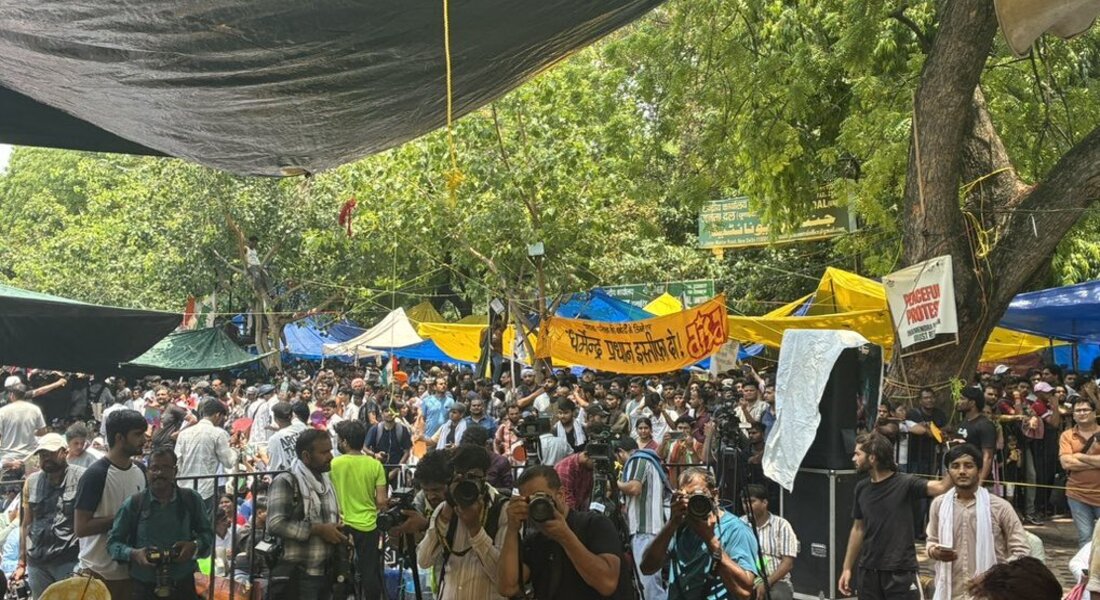

New Delhi: The Cockroach Janta Party (CJP) on Wednesday rejected an invitation to meet Union Health Minister J.P. Nadda at his residence, insisting that any dialogue with the government should take place either at Delhi’s Jantar Mantar, where its protest is underway, or at a neutral venue nearby.
Addressing reporters at the protest site, CJP chief spokesperson Saurav Das said the party had once again been approached by the police, who conveyed that Nadda wished to hold discussions with the protesters.
“This morning, the police reached out to us again and informed us that J.P. Nadda wanted to speak with us. They invited us to his residence, but we categorically declined. We are not going to anyone’s house or office. A ‘janata darbar’ is being held here, and if the ministers want to talk, they should come to the people,” Das said.
He, however, said the party remained open to dialogue if the government was serious about addressing its demands. “If there are security concerns about ministers visiting Jantar Mantar, we are willing to meet at a neutral venue such as the Constitution Club near the protest site. But the government must first clarify whether it genuinely intends to engage with us. There is no point in holding meaningless discussions,” he added.
The remarks came as the CJP’s indefinite protest entered another day, with thousands of students and supporters continuing their sit-in at Jantar Mantar demanding the resignation of Union Education Minister Dharmendra Pradhan over alleged irregularities in the NEET examination. In a post on X, the party reiterated that it would not end the protest until Pradhan stepped down.
CJP spokesperson Ashutosh Ranka claimed the movement was gaining momentum and warned that “millions more” would join if the government failed to respond to the protesters’ demands.
Amid escalating tensions, the Ministry of Home Affairs ordered the deployment of 20 additional companies of the Central Reserve Police Force (CRPF) to Delhi, with personnel being moved from West Bengal to reinforce security arrangements.
Heavy security remained in place across central Delhi, particularly around Parliament House and Rafi Marg, while Delhi Police continued extensive barricading following Monday’s confrontation between protesters and security personnel.
The Delhi Metro Rail Corporation (DMRC) also closed 16 Metro stations, including Rajiv Chowk, Central Secretariat, Mandi House, ITO, Khan Market, Janpath and Lok Kalyan Marg, citing security reasons. While train interchange facilities remained available at select stations, entry and exit were suspended until further notice.
Criticising the closures, Aam Aadmi Party national convenor Arvind Kejriwal said shutting Metro stations would not deter the youth. “Even if all Metro stations are closed, young people will walk to join the protest. The more the government tries to suppress the movement, the stronger it will become,” he said during a joint press conference with Shiv Sena (UBT) chief Uddhav Thackeray.
The protest also found support outside Delhi. Students of Mahatma Gandhi Kashi Vidyapith in Varanasi announced solidarity demonstrations demanding Pradhan’s resignation, while police in Patna used tear gas and water cannons to disperse AISA workers protesting over the alleged NEET paper leak. Solidarity protest marches have also been carried out in many other places across the country following the police crackdown of protesters in Delhi.
Meanwhile, the health condition of 21-year-old Sakshi, who was critically injured during Monday’s police action, showed significant improvement. Doctors at Delhi’s Ram Manohar Lohia Hospital said she had been taken off ventilator support, was conscious, breathing on her own and responding appropriately to commands. MRI scans of her brain and spine were reported to be normal, and doctors said her condition was steadily improving under close medical supervision.
DMK MPs A. Raja, Dayanidhi Maran and Jagathrakshakan visited RML Hospital to enquire about the condition of injured students. Raja alleged that hospital authorities were under pressure from the Centre to restrict access to patients without the approval of the Union Health Minister.
In a statement issued later in the day, the CJP appealed to activist Sonam Wangchuk to end his indefinite hunger strike, saying his health was too important to be put at further risk. The party assured Wangchuk that his sacrifice had inspired an entire generation and vowed to continue the agitation peacefully until its demands were met. CJP founder Abhijeet Dipke urged Wangchuk to prioritise his health, saying the movement would carry forward with renewed determination.
AAP MP Sanjay Singh also extended support to Wangchuk’s agitation, urging political parties and citizens across the country to stand behind the protest. He noted that Wangchuk had been on an indefinite hunger strike for more than three weeks and said the movement had become a national cause.
Meanwhile, Parliament witnessed fresh political sparring over the NEET controversy. The government informed the Lok Sabha that it was ready for a detailed discussion on the alleged paper leak. Union Education Minister Dharmendra Pradhan reportedly met Lok Sabha Speaker Om Birla after the government expressed its willingness to hold a debate. However, Opposition parties maintained that any discussion must also address their demand for Pradhan’s resignation.
Delhi Police, meanwhile, continued its investigation into Monday’s violence. Six FIRs have been registered at different police stations over alleged violence, vandalism and other offences during the Parliament march. Police said they were also probing what they described as a possible larger criminal conspiracy behind the unrest.
Separately, an FIR has been registered over a video purportedly showing a Rapid Action Force (RAF) personnel being chased and assaulted by a group of protesters during Monday’s march.
Despite the heavy security presence and continuing police action, CJP leaders said the protest at Jantar Mantar would continue until the government accepted their demands, maintaining that they remained open to talks provided they took place in public or at a mutually agreed neutral venue.