
Across villages in Haryana, Rajasthan, and Punjab, community-led interventions in sustainable farming, water conservation, and waste management are helping vulnerable communities adapt to environmental challenges while building healthier and more resilient futures.
In many villages across northern India, environmental degradation is no longer a distant or abstract concern — it is an everyday reality. Shrinking water bodies, depleting groundwater, erratic weather patterns, declining soil productivity, and unmanaged waste are increasingly threatening livelihoods, public health, and ecological balance.
Yet, amid these growing environmental challenges, a quiet transformation is unfolding across rural communities in Haryana, Rajasthan, and Punjab. Supported by grassroots organisation Akhil Bhartiya Gramin Uthan Samiti (ABGUS) and SBI Foundation, several communities are not only adapting to environmental stress but actively building resilience through locally owned and sustainable solutions.
As the world marks World Environment Day under the theme “Inspired by Nature. For Climate. For Our Future,” these grassroots interventions offer an important reminder: some of the most effective climate solutions already exist in nature and within communities themselves. From restoring water bodies and improving farming systems to reducing waste and strengthening environmental awareness, rural communities are proving that climate resilience begins at the grassroots.
Swapan Dhar, Managing Director & CEO of SBI Foundation, says the Foundation remains committed to strengthening rural resilience through sustainable and community-led development.
“Environmental conservation and sustainable water management have been key priorities under our Gram Saksham project. Interventions such as pond rejuvenation, solar electrification, and natural resource management in Nuh district, implemented with ABGUS, reflect this commitment. Beyond conservation, these efforts are strengthening community resilience and improving rural well-being. We are encouraged by the outcomes and hopeful that communities will continue to take ownership of these interventions,” Dhar adds.
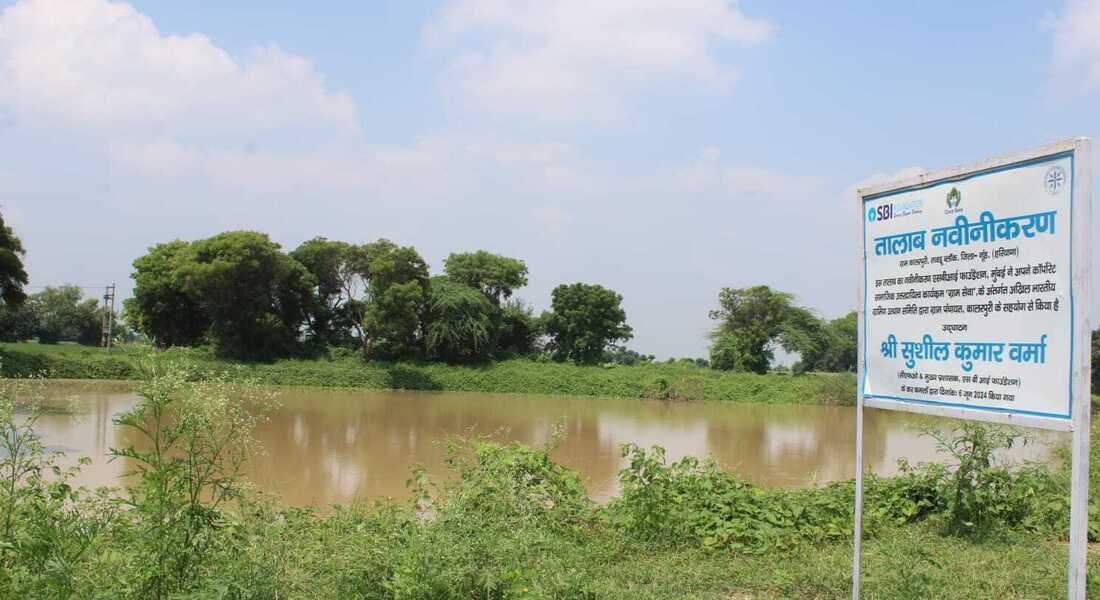
Under SBI Gram Saksham, ABGUS is currently supporting the rejuvenation of 20 village ponds along with catchment development, solar street lighting, quality seed distribution, and community training on water sustainability and natural resource management.
For nearly four decades, ABGUS has worked with vulnerable and marginalised communities across northern India. Over the years, environmental sustainability has increasingly emerged as a cross-cutting pillar across its programmes — spanning rural livelihoods, agriculture, water conservation, sanitation, and public health.
“Environmental protection cannot happen only through policies or large campaigns,” says Rajesh Verma, Founder and Secretary of ABGUS. “Real change begins when communities understand that their future is directly connected with how they manage water, land, forests, and waste. Our role is to strengthen that understanding and support people in adopting practical solutions.”
Restoring Water Security Through Community Action
Water conservation forms one of the strongest pillars of ABGUS’s environmental interventions.
Across operational geographies, the organisation has worked extensively on watershed management, pond rejuvenation, groundwater recharge, catchment restoration, and water-efficient agricultural practices, particularly in environmentally stressed regions vulnerable to declining groundwater and salinity.
According to independent assessments, ABGUS’s interventions have contributed to a 245% increase in pond storage capacity, significantly improving local water availability and strengthening water security for vulnerable communities.
Over the years, the organisation has rejuvenated 205 water bodies and associated catchment areas, benefiting nearly five lakh people across intervention regions. Efforts to improve safe drinking water access have also reached over 212,575 residents through 26 community RO systems and mobile water units.
The environmental approach is both ecological and livelihood-oriented. By restoring ponds and catchments, the organisation aims to capture and retain monsoon runoff that would otherwise be lost, while improving irrigation potential for farming communities. Interventions have focused on:
- Rejuvenating village ponds and water bodies to increase holding capacity
- Developing catchment areas to improve rainwater harvesting and groundwater recharge
- Land levelling to enhance water retention and agricultural productivity
- Tree plantation around water bodies and common lands to strengthen ecological restoration
- Community awareness campaigns promoting responsible water use and conservation
In districts such as Nuh, Tapukara, and Rewari, the organisation has also worked to revive ecological systems around degraded landscapes.
Environmental conservation efforts have included reforestation and afforestation initiatives, particularly in the Aravali region of Haryana and Rajasthan, where dense green cover has been promoted to combat ecological degradation and biodiversity loss.
Community engagement has remained central to these efforts. Through village meetings, awareness sessions, and partnerships with experts, communities are being sensitised to the importance of ecosystem protection, wildlife conservation, and sustainable natural resource management.
Mass awareness campaigns conducted along the Sahibi River and its tributaries have brought together communities through village dialogues, Nukkad Nataks (street theatre), wall campaigns, and padyatras, encouraging residents to become active participants in river conservation.
“Water conservation is no longer optional,” Verma says. “Communities are already experiencing changing rainfall patterns and increasing pressure on groundwater. Reviving traditional systems and strengthening collective ownership of water resources are essential for long-term sustainability.”
One of the key environmental challenges in intervention areas has been water scarcity and rising groundwater salinity, largely due to overdependence on deep borewells. By rejuvenating village ponds and promoting a surface-water-centric irrigation approach, ABGUS is trying to help communities reduce dependence on overexploited groundwater while naturally supporting aquifer recharge and salinity dilution.
Community ownership has emerged as the defining strength of these interventions.
Village meetings have become spaces for discussing water usage, monitoring progress, and collectively addressing environmental challenges. Panchayati Raj Institutions (PRIs), Village Development Committees (VDCs), frontline workers, and youth groups have also played an important role in spreading awareness and strengthening responsible water management practices.
So far, more than 1,100 frontline workers, PRI members, and youth leaders have been mobilised through specialised outreach programmes, helping build local leadership around environmental stewardship.
For residents, the impact extends beyond improved water availability.
“The pond restoration project brought our community together. With the Gram Panchayat leading the way, we collectively took ownership and responsibility for the work,” says Ramesh, a resident of Akera village in Nuh district. “Today, it is not just a water source — it gives us confidence and a sense of pride that we built something sustainable together.”
Building Cleaner Villages Through Waste Management
For ABGUS, environmental sustainability is inseparable from public health and dignified living conditions.
Across several project villages, the organisation has implemented community-based waste management initiatives, aligned with the goals of the Swachh Bharat Mission, to create cleaner and healthier surroundings.
The interventions focus on waste segregation, proper disposal systems, community cleanliness drives, hygiene awareness, and household-level training on safe waste management practices.
Dustbins have been installed at schools, ICDS centres, and community spaces to encourage responsible waste disposal, while sustained behaviour change campaigns through village meetings and mobilisation drives continue to strengthen awareness.
For many residents, the difference is tangible.
“Earlier, our village had no proper system for waste disposal. Garbage piled up on roads, drains remained clogged, and the fear of diseases like dengue and malaria was constant,” recalls Ramchandra, a resident of Para village and member of the Gram Seva Committee.
Today, improved waste management practices are helping communities maintain cleaner surroundings, reduce health risks, and strengthen environmental responsibility at the household level.
The emphasis on community ownership has ensured that waste management is not seen as an externally imposed intervention, but as a shared responsibility for collective wellbeing.
Reimagining Farming Through Climate-Smart Agriculture
Among ABGUS’s most promising environmental interventions linked with sustainable farming and livelihood is its work around multi-cropping and climate-smart agriculture, particularly under the Gram Seva programme supported by SBI Foundation.
Traditional farming systems in several parts of Haryana rely heavily on water-intensive mono-cropping, leaving farmers vulnerable to climate variability, increasing input costs, and declining returns.
To address this, ABGUS introduced a diversified multi-cropping model, allowing farmers to cultivate multiple crops simultaneously on the same piece of land. Often described as vertical or layered farming, the approach enables farmers to maximise land productivity, conserve water, reduce cultivation risks, lower carbon-intensive inputs, and diversify incomes.
By improving soil health and reducing water dependency, the model offers a practical example of how farming systems can become both economically and environmentally sustainable.
“Communities are not victims of environmental change — they can become leaders of environmental solutions,” Verma says. “Our experience over the years shows that when people are trusted, trained, and supported, sustainable change becomes possible.”
Beyond Conservation: Building Climate-Resilient Communities
What makes ABGUS’s environmental model distinctive is its integrated approach.
Rather than treating conservation as a standalone intervention, the organisation links environmental restoration with livelihoods, agriculture, public health, local governance, and community leadership. This ensures that climate action translates into better incomes, healthier communities, stronger institutions, and long-term sustainability.
As climate vulnerabilities intensify, grassroots organisations are increasingly playing a critical role in demonstrating practical and locally relevant solutions.
On this World Environment Day, the story unfolding across these villages offers an important lesson aligned with this year’s theme: “Inspired by Nature. For Climate. For Our Future.” Whether through restoring ponds, protecting ecosystems, improving farming systems, or mobilising communities, the path to climate resilience may well begin by rebuilding our relationship with nature — together.
***
Sumit Kumar Sinha is a social worker and development professional with 15 years of experience in community development. Passionate about storytelling, he uses writing to inspire awareness and positive social change. The views expressed are personal and do not necessarily reflect those of IndiaVerve.