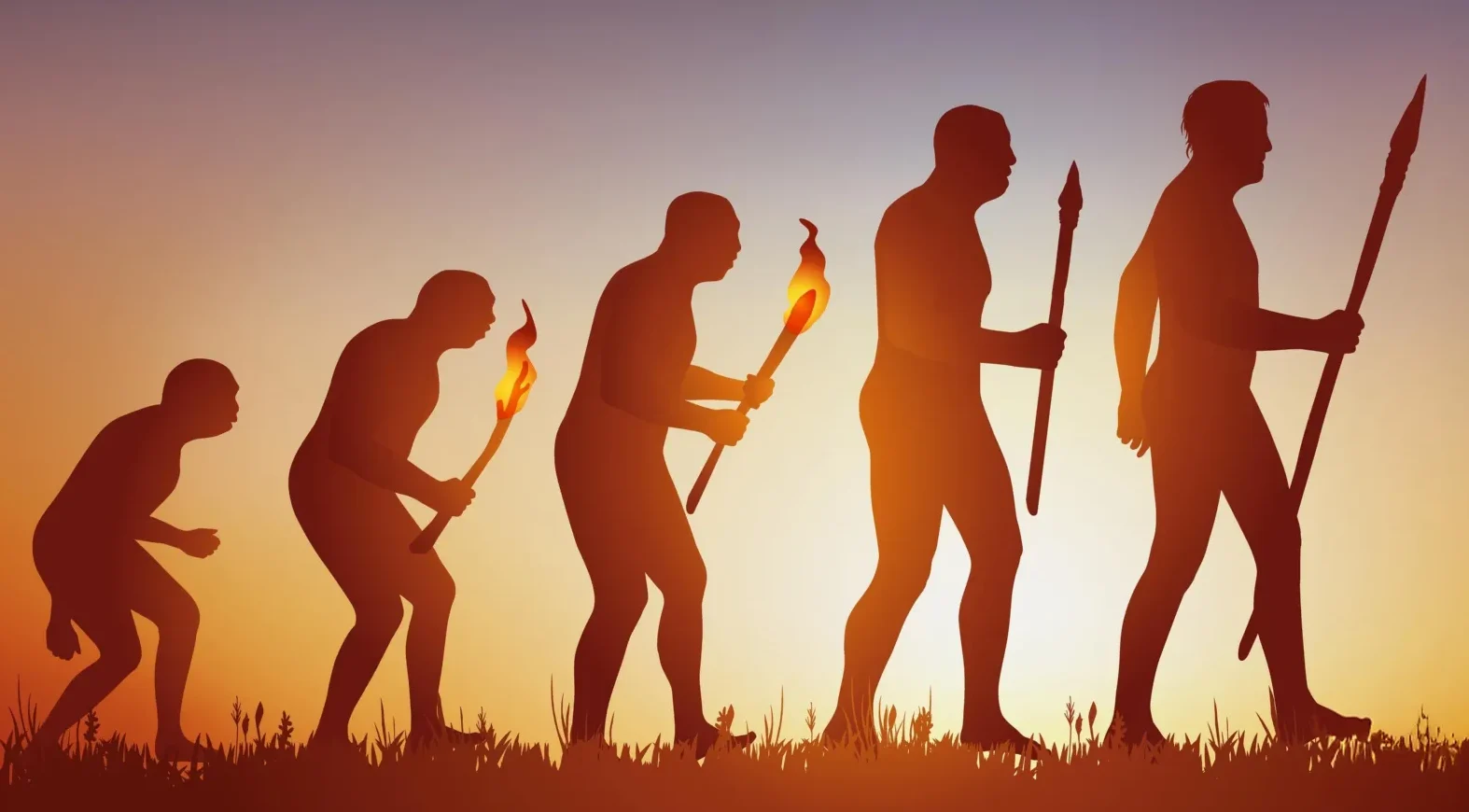

London: Humans evolved larger brains and flatter faces at an exceptionally rapid pace compared to other apes, according to new research from University College London (UCL). The study found that human skulls changed about twice as much as expected under normal evolutionary rates, suggesting that powerful forces—both cognitive and social—drove the distinct features that define our species today.
The research, published in the journal Proceedings of the Royal Society B, compared 3D models of skulls from various ape species, including humans, gorillas, chimpanzees, and gibbons. The findings revealed that humans’ skulls evolved at a much faster rate than any other closely related species, reflecting a unique evolutionary trajectory linked to brain expansion and facial flattening.
Lead author Dr. Aida Gomez-Robles from UCL Anthropology said,“Of all the ape species, humans have evolved the fastest. This likely speaks to how crucial skull adaptations associated with having a big brain and small faces are for humans that they evolved at such a fast rate.”
“These adaptations can be related to the cognitive advantages of having a big brain, but there could be social factors influencing our evolution as well,” Dr. Gomez-Robles was quoted as saying by ScienceDaily.
To conduct the study, the researchers created detailed three-dimensional digital models of skulls from seven great ape species, including humans, gorillas, and chimpanzees, as well as nine lesser ape species such as gibbons. These two groups diverged from a common ancestor around 20 million years ago. While gibbons have remained relatively uniform in skull structure, great apes—particularly humans—showed much greater diversity.
Each skull was divided into four regions: the upper face, the lower face, the front of the head, and the back of the head. Using computer analysis, the researchers measured how much each section varied between species, providing one of the most detailed comparative studies of ape skull structure to date.
The results showed that while most great apes have large, forward-projecting faces and smaller brains, humans developed rounder heads and much flatter faces. Although gibbons share some facial similarities with humans, such as a relatively flat face and round skull, their brains are far smaller.
By treating the slow rate of change in gibbons as a baseline, the researchers discovered that the human skull evolved roughly twice as fast as expected. This suggests that additional evolutionary pressures—beyond simple adaptation—accelerated the process.
However, Dr. Gomez-Robles cautioned against attributing this rapid evolution solely to intelligence. “After humans, gorillas have the second fastest evolutionary rate of their skulls, but their brains are relatively small compared to other great apes,” she said. “In their case, it’s likely that the changes were driven by social selection, where larger cranial crests on the top of their skulls are associated with higher social status. It’s possible that some similar, uniquely human social selection may have occurred in humans as well.”
The findings provide new insights into how both biological and social factors may have shaped the evolution of modern humans, highlighting the dynamic interplay between brain development, facial structure, and social behavior.