
New Delhi: Indian scientists have developed a new self-charging solar energy device that can capture sunlight and store it at the same time, marking a major step towards simpler and cleaner power systems.
The device, called a photo-capacitor, has been created by researchers at the Centre for Nano and Soft Matter Sciences (CeNS) in Bengaluru, according to an official release. Unlike conventional solar systems that use separate panels and batteries, this single unit performs both energy collection and storage.
Researchers said existing solar setups depend on complex power management electronics to balance energy flow between panels and storage units. This adds cost, increases energy loss, and makes devices bulkier, especially for small and portable applications.
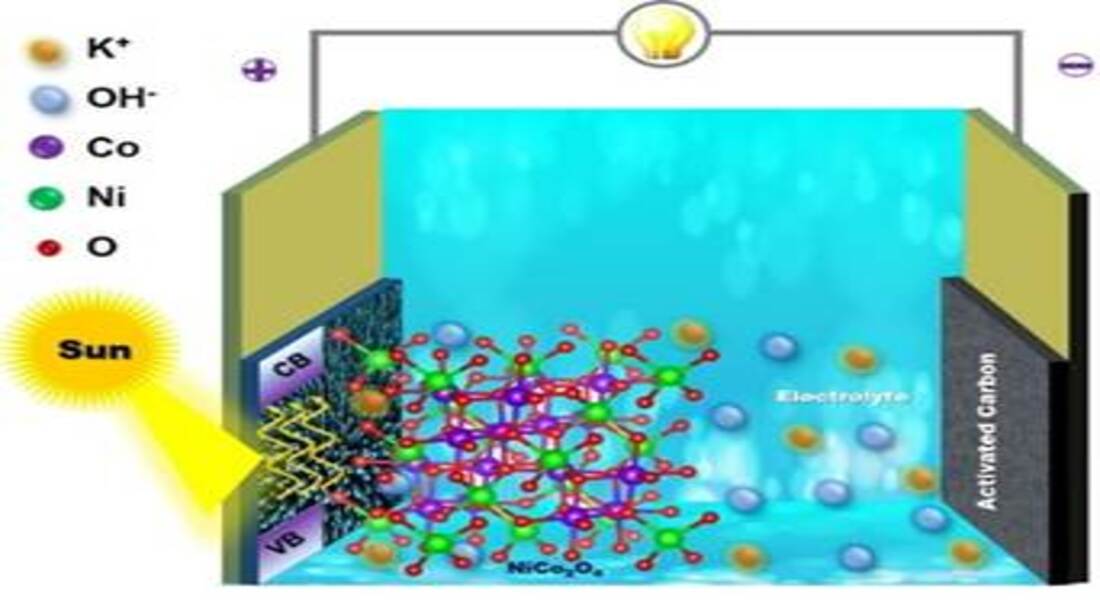
The newly developed photo-capacitor overcomes these challenges by integrating both functions into one compact system. It converts sunlight directly into electrical energy and stores it without the need for external circuitry, according to a Ministry of Science & Technology release.
The team, working under the guidance of Dr Kavita Pandey, used nickel-cobalt oxide nanowires grown on nickel foam through a simple hydrothermal process. These ultra-thin nanowires form a porous three-dimensional network that absorbs light efficiently and stores electric charge at the same time.
Tests showed that the device’s energy storage capacity increased by 54 per cent when exposed to light. Even after 10,000 charge and discharge cycles, it retained 85 per cent of its original capacity, highlighting its durability.
To test real-world use, the scientists built a complete photo-supercapacitor using activated carbon and the nanowire electrode. The device delivered a stable output of 1.2 volts and continued to perform well under different lighting conditions, from indoor light to strong sunlight.
The self-charging solar energy device also showed high stability over repeated photo-charging cycles, indicating it can withstand long-term use. Researchers said this makes it suitable for portable electronics, wearable devices and off-grid power systems.
Theoretical studies conducted alongside experiments revealed why the material performs so well. Nickel substitution in the material reduced the band gap and improved charge movement, enabling faster and more efficient energy storage.
The study, published in the journal Sustainable Energy & Fuels, highlights how combining sunlight capture and storage in a single device could reduce dependence on fossil fuels and traditional batteries.
Scientists believe that with further development, this self-charging solar energy device could support India’s clean energy goals and inspire similar innovations globally.