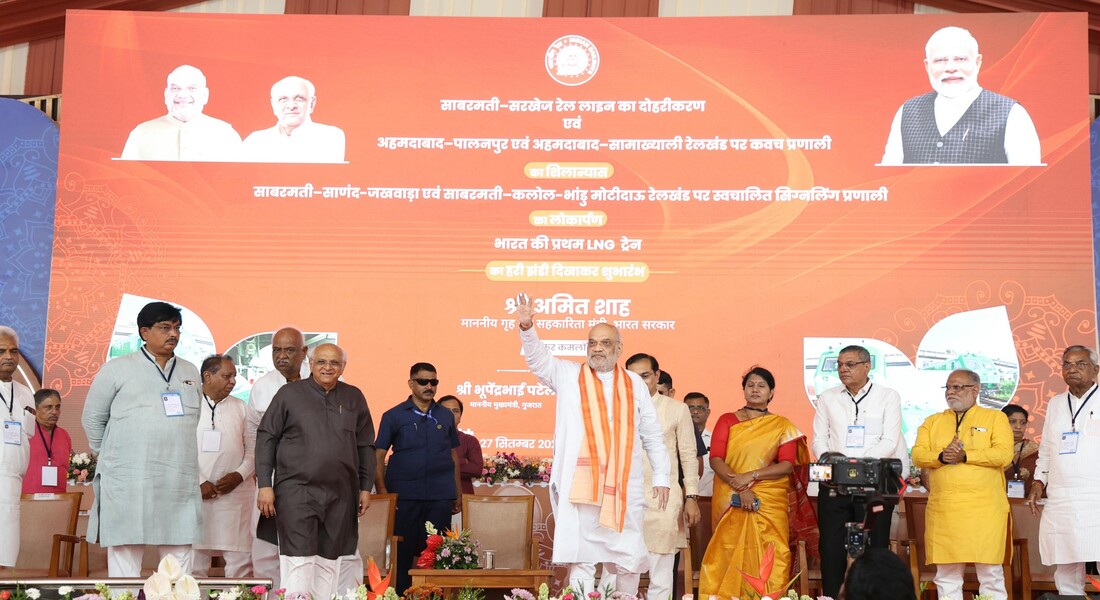

New Delhi: Union Home Minister and Minister of Cooperation Amit Shah on Sunday inaugurated railway development projects worth Rs 1,472 crore and flagged off the country’s first LNG-powered train from Sabarmati Railway Station in Ahmedabad, Gujarat.
Shah also inaugurated a WAG-12 Maintenance Shed built for the maintenance of railway locomotive engines. Gujarat Chief Minister Bhupendra Patel and other dignitaries were present at the programme, according to an official statement.
Speaking at the event, Shah said the projects launched in the Sabarmati division focus on environmental sustainability, passenger amenities and railway safety.
He highlighted the significance of Sabarmati, noting that several initiatives associated with Mahatma Gandhi, including Satyagraha, simple living, rural development and khadi, had their journey from the area.
He said Sabarmati Railway Station had undergone a major transformation in terms of passenger facilities, safety and connectivity.
Recalling its condition in the 1980s, Shah said passengers once had to walk nearly two kilometres from the station to find a rickshaw.
Among the major projects is the WAG-12 Maintenance Shed, constructed at a cost of Rs 700 crore. The Sabarmati–Kalol–Sabarmati rail section has also been equipped with the Kavach train protection system at a cost of Rs 48 crore.
Work has additionally begun on implementing Kavach on the Ahmedabad–Palanpur and Ahmedabad–Samakhiali sections and doubling the Sabarmati–Sarkhej railway line.
Shah also highlighted the commissioning of a 12,000-horsepower twin-section locomotive. According to him, a single WAG-12 can haul nearly as much freight as 600 trucks, replacing the need for two locomotives for the same task. He described the development as an important milestone for Indian Railways.
The LNG-powered train flagged off during the programme was also described as a step towards reducing the environmental impact of railway operations.
Shah said several railway modernisation initiatives had been undertaken since Narendra Modi became Prime Minister in 2014. He cited the successful trial of the country’s first double-stack long-haul container train between Jawaharlal Nehru Port Trust in Mumbai and Vadodara, saying the concept could nearly double freight-carrying capacity where rail tracks are limited.
He further said an 11,000-kilometre-long corridor is being converted into a four-lane network to facilitate traffic movement towards Delhi–Howrah and Delhi–Guwahati.
The Union home minister also referred to the introduction of Dedicated Freight Corridors, the Rapid Rail System and premium railway stations under the Modi government. He said India had recently seen the inauguration of a hydrogen-powered train, placing the country among only four nations with the technology.
According to figures cited by Shah, 97% of bio-toilets were installed during the Modi government’s tenure, while 87% of LHB coaches were manufactured in India. He said railway electrification, which stood at 30% before 2014, had reached 99.6%, with the remaining 0.4% expected to be completed soon.
Shah said railway electrification increased from 75 kilometres in 2010–11 to 7,188 kilometres in 2023–24. He also compared India’s reported electrification level with China, Spain, France and the UK, and said India would achieve complete electrification.
He said diesel consumption by the railways declined from 293 crore litres in 2015–16 to 108 crore litres in 2024–25. He also cited a 67% increase in the railway safety budget and a 66% rise in locomotive production capacity under the Modi government.
Turning to Gujarat’s railway allocation, Shah said the state’s rail budget during 2009-14 was Rs 589 crore, compared with Rs 17,366 crore allocated for 2026–27. He said the figures reflected the pace of development in the state.
During his address, Shah also criticised opposition parties over their statements on the government’s performance. He alleged that corruption, scams and scandals involving ₹12 lakh crore had taken place over a decade under the previous government and said no allegation of corruption had been levelled against Prime Minister Modi in 12 years.
The projects inaugurated and launched at Sabarmati are expected to strengthen railway infrastructure in the region while covering freight movement, passenger facilities, safety and cleaner fuel use.