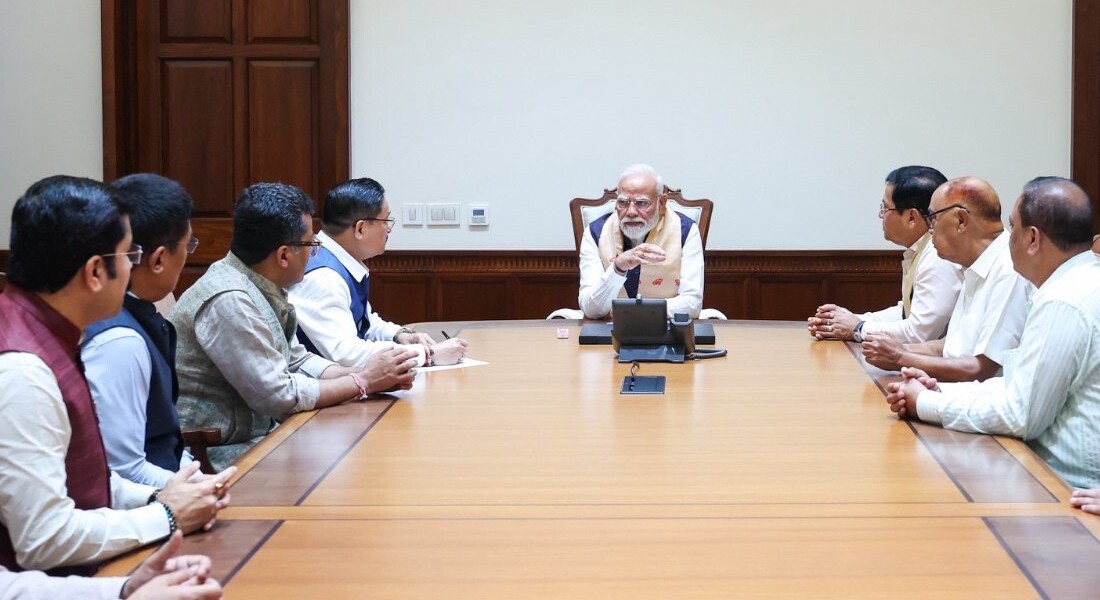

New Delhi: The Union Cabinet, chaired by Prime Minister Narendra Modi, has approved three major national schemes with a combined outlay of more than Rs 4.04 lakh crore to strengthen India’s energy security, support farmers and accelerate the country’s clean energy transition.
The Cabinet approved the ‘Samudra Manthan’ – National Offshore Exploration Scheme, the continuation of the Pradhan Mantri Kisan Samman Nidhi (PM-KISAN) scheme, and the Pradhan Mantri Surya Sarovar Yojana (PM-SSY).
The Samudra Manthan scheme has been approved with an outlay of Rs 84,084 crore for implementation till FY 2030-31. The Central Sector scheme of the Ministry of Petroleum and Natural Gas aims to unlock India’s offshore oil and gas potential and strengthen the country’s long-term energy security, according to an official statement.
The scheme includes large-scale acquisition, processing and interpretation of seismic data, accelerated deepwater and ultra-deepwater exploratory drilling, scientific drilling in frontier basins, development of common offshore production and evacuation infrastructure, and the establishment of an integrated Oil and Gas Manufacturing and Services Zone.
It also provides for digital programme management, technology adoption, capacity building, stakeholder engagement and international outreach.
According to the government, the initiative is expected to add more than 600 Million Metric Tons of Oil Equivalent to India’s reserves. It is also projected to increase offshore exploration, boost domestic oil and gas production, generate employment, strengthen indigenous manufacturing under Make in India and Aatmanirbhar Bharat, and attract investments across the exploration and production value chain.
The Cabinet also approved the continuation of the PM-KISAN scheme from 2026-27 to 2030-31 with a financial outlay of Rs 3.15 lakh crore.
Launched in February 2019, the scheme provides Rs 6,000 annually to eligible landholding farmer families through the Direct Benefit Transfer system in three equal instalments.
The government said more than Rs 4.47 lakh crore has been transferred directly to farmers through 23 instalments since the scheme’s launch. Under the 23rd instalment, over 9.49 crore farmers received more than ₹18,984 crore.
According to the government, PM-KISAN has enabled farmers to invest in seeds, fertilisers, irrigation, agricultural machinery and other farm inputs. Independent evaluations cited by the government found that more than 92% of beneficiaries used the assistance for agricultural activities, while around 85% reported improved farm income and reduced dependence on informal credit.
In another decision, the Cabinet approved the PM-SSY with a total outlay of Rs 5,070 crore.
The scheme aims to develop 5,000 MW of floating solar photovoltaic projects with co-located Energy Storage Systems having a minimum storage capacity of 10,000 MWh. The projects will be sanctioned between FY 2026-27 and FY 2030-31, while financial support will continue till FY 2032-33.
The approval follows an assessment by the National Institute of Solar Energy, which estimated a floating solar potential of around 102.18 GWp across reservoirs and other suitable inland water bodies.
Under the scheme, the Centre will provide financial assistance of Rs 1 crore per MW for eligible floating solar projects after successful commissioning. It will also provide up to Rs 50 lakh per project for feasibility studies and other preparatory activities.
The government said the scheme will add 5,000 MW of floating solar capacity, strengthen grid reliability through integrated energy storage, reduce around 10 million tonnes of CO₂ emissions annually, generate approximately 16,000-17,000 full-time equivalent employment opportunities, promote domestic manufacturing of solar and energy storage equipment, and contribute to India’s renewable energy and climate goals.