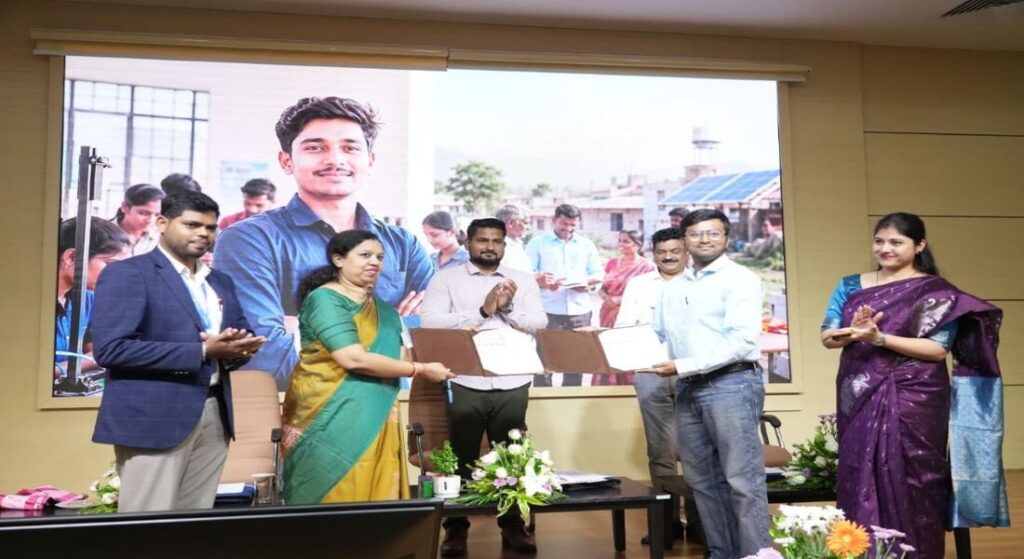
New Delhi: The Indian Institute of Technology Delhi (IIT Delhi) has signed a Memorandum of Understanding (MoU) with Jindal Steel to set up a Nodal Centre of Excellence (CoE) focused on structural steel research, design innovation, and skill development.
The initiative emphasizes high-strength and performance-oriented steel applications.
The Centre aims to promote wider use of structural steel in construction, supporting sustainable buildings, faster infrastructure delivery, and reduced life-cycle costs across the country.
The Nodal CoE will serve as a bridge between research, design, fabrication, and construction, according to the IIT Delhi. Its work will cover housing, bridges, tall buildings, and industrial structures, advancing high-strength steel applications. The Centre will also focus on modernising design codes and standards, encouraging performance-based design, durability, multi-hazard resilience, low-damage systems, and reducing carbon footprint.
Capacity building will be a key component, with workshops, specialised courses, digital platforms, and direct design support for infrastructure projects. The Centre will also establish Chair Professorships to attract global expertise and strengthen industry-linked research in performance-oriented structural steel.
As a national nodal body, the Centre will coordinate with multiple IITs, ministries, industry partners, and professional organisations to ensure research, skill development, technology transfer, and outreach are aligned.
Prof. Rangan Banerjee, Director of the IIT Delhi, said that the institute was pleased to partner with Jindal Steel to establish the Nodal CoE. He stated that the Centre would bring academic rigour to structural steel research, particularly in high-strength applications.
He added that it would help review design methodologies and performance frameworks suited to Indian conditions. According to him, the collaboration would enable IIT Delhi to generate knowledge, develop reference materials, and support capacity building for engineers.
He further noted that it would encourage sustained dialogue between researchers, policymakers, and professionals, which he described as essential for advancing structural steel construction in India.
Under a hub-and-spoke model, IIT Delhi will lead the initiative technically, while IIT Bombay, IIT Hyderabad, IIT Madras, and IIT Roorkee will contribute through research, outreach, training, curriculum development, and handbook preparation. This structured framework aims to strengthen structural steel construction nationwide.