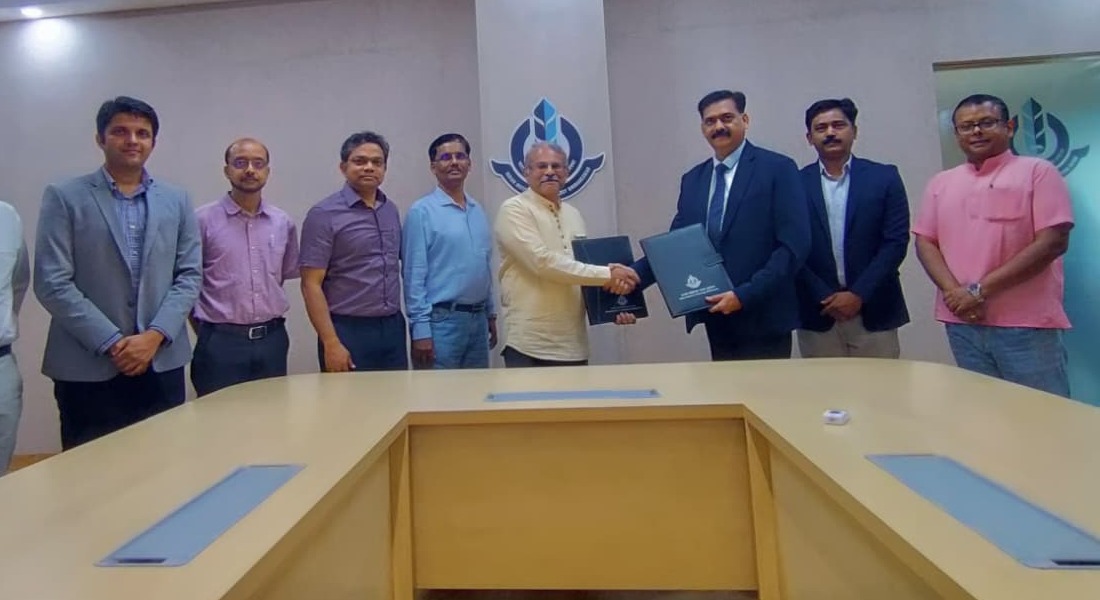

Bhubaneswar: Indian Institute of Technology (IIT) Bhubaneswar and the National Fire Service College (NFSC), Nagpur, under the Ministry of Home Affairs, have signed a Memorandum of Understanding (MoU) at IIT Bhubaneswar to strengthen collaboration in education, research, and capacity building.
The MoU was formally exchanged between Dr. A. R. Sontake, Professor and Director of NFSC, and Prof. Shreepad Karmalkar, Director of IIT Bhubaneswar. The signing ceremony was held in the presence of several faculty members, including Prof. Arun Kumar Pradhan, Head of the School of Mechanical Sciences; Prof. P. Dinakar, Dean (SRIC); Prof. Mihir Kumar Pandit; Dr. Prasenjit Rath, Associate Professor; Dr. Amrit B. Sahu, Assistant Professor; and Shri N. Aravindan, Assistant Professor at NFSC.
The agreement establishes a comprehensive framework for academic, research, and technical collaboration between the two institutions, the NFSC said in a release.
It includes joint research and development projects, faculty and student exchange programmes, and joint supervision of student projects, theses, and dissertations. The MoU also covers collaborative submission and execution of externally funded research and consultancy projects.
In addition, the partnership enables shared use of laboratory facilities, testing infrastructure, and research equipment. It also provides for the joint organisation of workshops, conferences, seminars, training programmes, and short-term courses.
Under the collaboration, both institutions may jointly identify, apply for, and execute projects supported by government agencies, public sector undertakings, industries, and international organisations. The MoU further outlines a structured framework for intellectual property rights management, joint publications, and dissemination of research outcomes.
The agreement has been guided and approved by Sunil Kumar Jha, DG (FS, CD & HG), Ministry of Home Affairs, reflecting the ministry’s commitment to strengthening academic and research collaboration in fire engineering and safety.
The collaboration is expected to enhance academic excellence, research innovation, and technical capabilities in fire engineering and safety, contributing to national development and resilience.