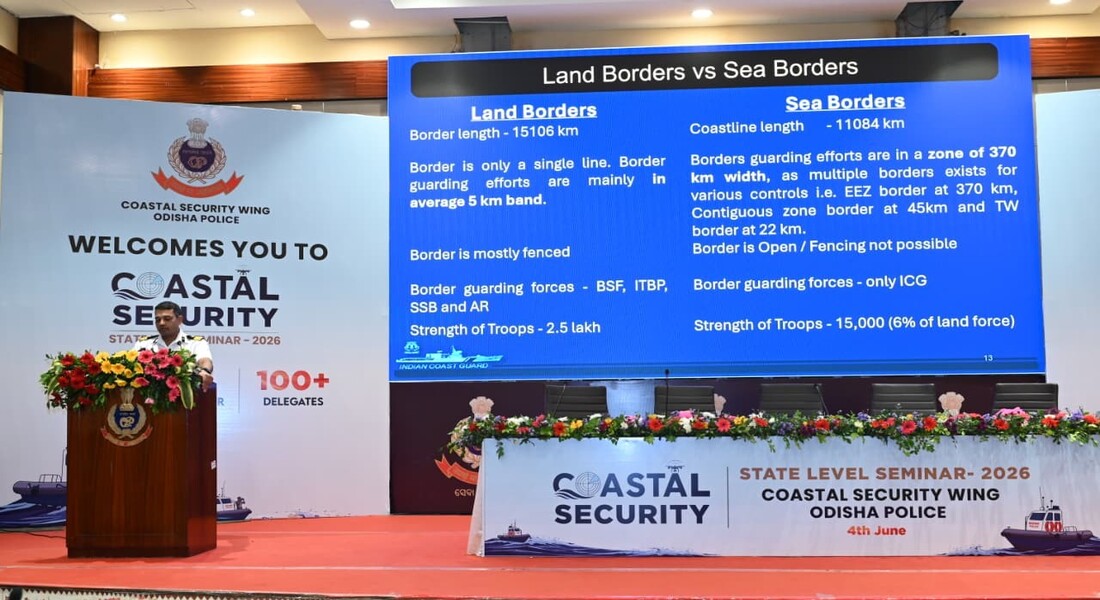

BHUBANESWAR: Maritime security, coastal surveillance, and protection of critical coastal infrastructure emerged as key focus areas during various sessions of the State Coastal Security Conference 2026, where senior officials from the Indian Coast Guard, Central Industrial Security Force (CISF), and Odisha Police outlined strategies aimed at strengthening India’s coastal security architecture.
The conference, held at Police Bhawan in Bhubaneswar, featured presentations on emerging security challenges, technological interventions, and inter-agency coordination mechanisms required to safeguard the country’s coastline and maritime assets, Odisha Police said in a series of posts on X.
During a conference session, Pankaj Verma, TM, Deputy Inspector General and Chief Staff Officer of the Indian Coast Guard Regional Headquarters (North East), Kolkata, delivered a presentation on modern defensive tactics and the future of coastal security.
He highlighted the adoption of advanced technological solutions for coastal surveillance as a key priority for the next generation of maritime security. The officer also stressed the importance of deploying e-surveillance systems for real-time monitoring and enhancing Maritime Domain Awareness to strengthen situational intelligence across coastal regions.
According to the presentation, these focus areas aim to reinforce India’s maritime security framework through innovation and greater synergy among agencies involved in coastal security operations.
In the afternoon session, Sidharth Paul, Commandant, CISF, Kochi, addressed delegates on the topic, “Security of Fishing Port and Fishing Vessel Management in High Density Zones: Risks & Challenges.”
He outlined the CISF’s mandate and discussed international conventions, national laws, and the role of multi-agency coordination in securing maritime infrastructure.
The presentation highlighted that the CISF is responsible for securing India’s 13 major seaports, coastal refineries, and nuclear installations. It also noted that the force’s jurisdiction extends to more than 250 seaports and over 1,200 fishing harbours across the country.
Commandant Paul further elaborated on the International Convention for the Safety of Life at Sea and the International Ship and Port Facility Security Code, describing them as key international frameworks that mandate the appointment of security officers, including Port Facility Security Officers, Ship Security Officers, and Company Security Officers, along with the implementation of Port and Ship Security Plans.
The session also highlighted the national legal framework governing maritime security, including the Merchant Shipping Act, the Major Port Authorities Act, 2021, the Indian Ports Act, 1908, and directives issued by the Directorate General of Shipping.
Emphasising the need for coordinated action, the presentation noted that effective port security depends on close cooperation among port authorities, the Indian Coast Guard, Customs, intelligence agencies, and state police forces.
According to Odisha Police, the session underscored the CISF’s role in protecting maritime economic infrastructure and ensuring security in high-density fishing zones.
Earlier, Arun Bothra, IPS, Additional Director General of Police, Coastal Security, Odisha Police, delivered a presentation on “Security Sensitivity Mapping at the Sea-Coast Interface” with special emphasis on FLC/FH zones.
The senior police officer outlined a series of modernisation initiatives being undertaken to strengthen Odisha’s coastal security framework.
These include the establishment of a Marine Training Centre, deployment of drones for aerial surveillance, hiring of trawlers for extended sea patrols, and systematic security-sensitivity mapping of the coastline.
According to the presentation, the initiatives are intended to enhance surveillance capabilities, improve preparedness, and strengthen security along Odisha’s coast.
The conference brought together stakeholders involved in coastal and maritime security and highlighted the growing emphasis on technology-driven surveillance, institutional coordination, and infrastructure strengthening to address emerging security challenges in coastal areas.