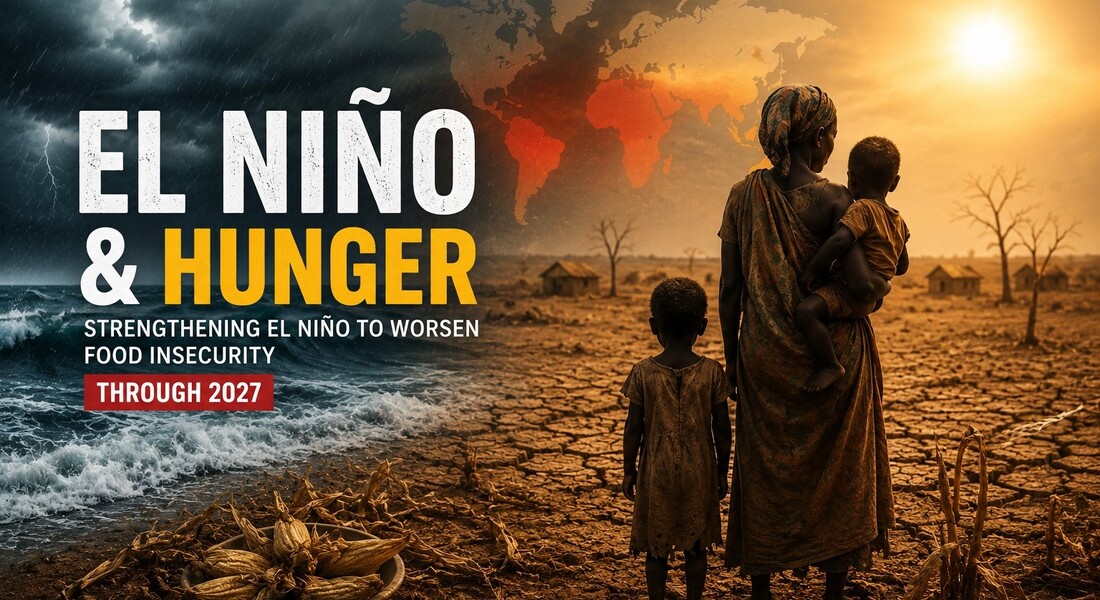

New Delhi: The UN World Food Programme (WFP) has said that the strengthening El Niño weather pattern is set to significantly worsen food insecurity in some of the world’s most vulnerable countries through 2027.
According to the agency’s latest analysis, the impacts of El Niño are already being felt by the most vulnerable communities on the frontlines of hunger, prompting WFP to ramp up its preparedness and response efforts.
Carl Skau, WFP’s Acting Executive Director, said El Niño posed a massive threat to the food security of millions of people who were already vulnerable. He said the sooner families were helped to prepare for climate shocks, the greater the agency’s ability to save lives and protect livelihoods.
According to him, severe floods and droughts could quickly push communities from coping into crisis.
He added that WFP was already scaling up early response efforts in eight countries and stood ready to do more.
El Niño is expected to peak between September and December 2026, though its effects are likely to be felt throughout 2027 owing to disruptions in future harvest cycles, the WFP said in a press release. The report noted that drought, flooding, and extreme temperatures were already putting communities at risk in several regions.
WFP said it was taking early action in partnership with the Food and Agriculture Organization, the UN Office for the Coordination of Humanitarian Affairs, and other agencies, with active anticipatory action plans now running in more than 50 countries.
Since May, the agency has triggered such plans in South Sudan, Chad, Mauritania, Uganda, Guatemala, and El Salvador, providing over USD 14 million in life-saving support to half a million people. This has included scaling up pre-arranged financing tools such as disaster risk insurance, credit lines, and digital payments to make funds available faster and at lower cost.
The agency said experience showed that every USD 1 invested in anticipatory programs could save between USD 3 and USD 7 in avoided losses and response costs.
WFP recalled that the 2015-2016 El Niño had affected the food security of 60 to 100 million people. Its early analysis now projects that the 2026-2027 El Niño could push at least 49 million more people into acute food insecurity by the end of 2027.
The analysis covered 45 countries already considered food insecure, where El Niño is expected to significantly alter rainfall patterns, temperatures, and the frequency of floods and droughts. Across these countries, the number of acutely food-insecure people is projected to rise from approximately 225 million to around 274 million, an increase of nearly 22%.