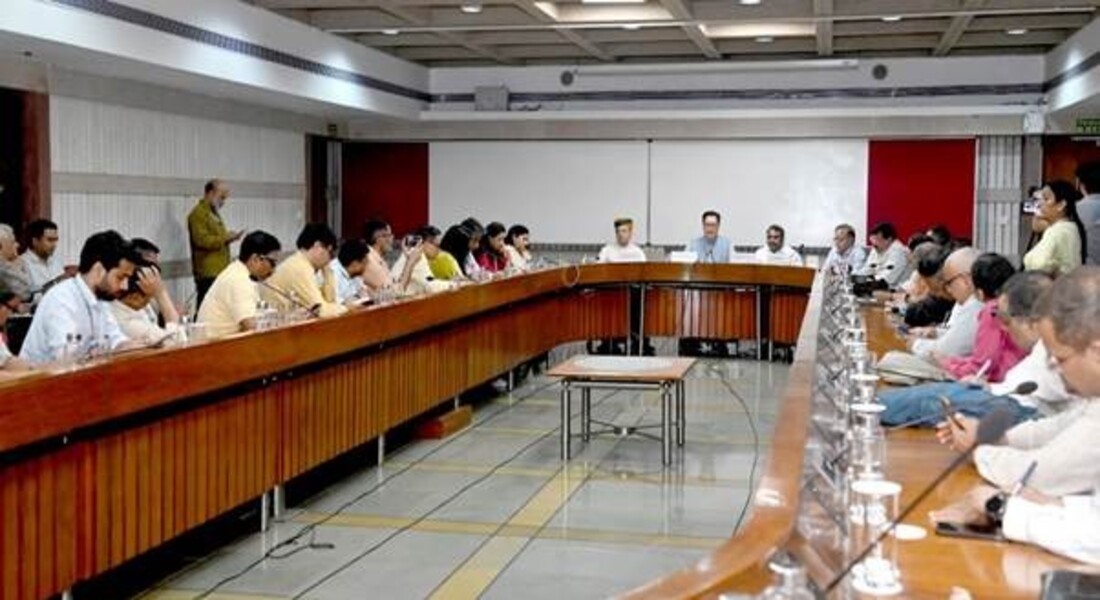

New Delhi: The Monsoon Session of Parliament, which commenced on July 20, 2026, was adjourned sine die on Thursday, August 13, after 19 sittings spread over 25 days.
During the session, 11 Bills were introduced in the Lok Sabha and 2 in the Rajya Sabha, while 12 Bills were passed by each House, taking the total number of Bills passed by both Houses to 12, according to an official statement.
Two Bills replacing Ordinances promulgated by the President before the session, namely the Supreme Court (Number of Judges) Amendment Ordinance, 2026 and the Income-Tax (Amendment) Ordinance, 2026, were considered and passed by both Houses.
Demands for Excess Grants for 2022-23 were also taken up, with the related Appropriation Bill passed by the Lok Sabha on August 4 and returned by the Rajya Sabha on August 6.
The Foreign Contribution (Regulation) Amendment Bill, 2026 was referred to a Joint Committee of the Houses for examination.
The Public Examinations (Prevention of Unfair Means) Amendment Bill, 2026 was introduced to strengthen the integrity of the public examination system and has since received presidential assent. The Bill ensures speedy investigation and time-bound trial of offences, mandating that investigations be completed within two months and trials within three months.
It empowers state governments and Union Territory administrations to designate Special Fast Track Courts and appoint Special Public Prosecutors, and enables the central government to constitute Special Task Forces for investigation wherever necessary.
The Bill also enhances penalties for offences and provides for a time-bound appellate mechanism before a Division Bench of the High Court.
Several other major Bills were passed by both Houses during the session. The Prevention of Insults to National Honour (Amendment) Bill, 2026 brings Vande Mataram within the ambit of the 1971 Act and makes it an offence to intentionally prevent its singing or disturb an assembly engaged in singing it.
The Registration of Births and Deaths (Amendment) Bill, 2026 makes delayed registration more stringent, requiring approval from an Executive Magistrate for registration after one to two years and from a Judicial Magistrate of the First Class after two years.
The Micro, Small and Medium Enterprises Development (Amendment) Bill, 2026 provides for a national digital platform for free MSME registration and decriminalises certain offences by replacing conviction-based fines with graded penalties.
The Bankers’ Books Evidence Bill, 2026 expands the definition of “bankers’ books” to include physical, electronic, digital, virtual and cloud-based records and creates a technology-neutral legal framework. The Kerala (Alteration of Name) Bill, 2026 amends the Constitution to alter the name of the State of Kerala to “Keralam”.
The National Co-operative Development Corporation (Amendment) Bill, 2026 expands the definition of “foodstuffs” and removes geographical restrictions applicable to industrial goods to strengthen the co-operative sector.
The Tribunals Reforms Bill, 2026 establishes a National Tribunals Commission to ensure independence, transparency and uniformity in the appointment and functioning of tribunals.
The Mines and Minerals (Development and Regulation) Amendment Bill, 2026 seeks to bring stability to the fiscal regime in the mineral sector in support of the Atmanirbhar Bharat and Viksit Bharat 2047 goals.
The productivity of the Lok Sabha during the session stood at approximately 19%, while that of the Rajya Sabha stood at approximately 39%.