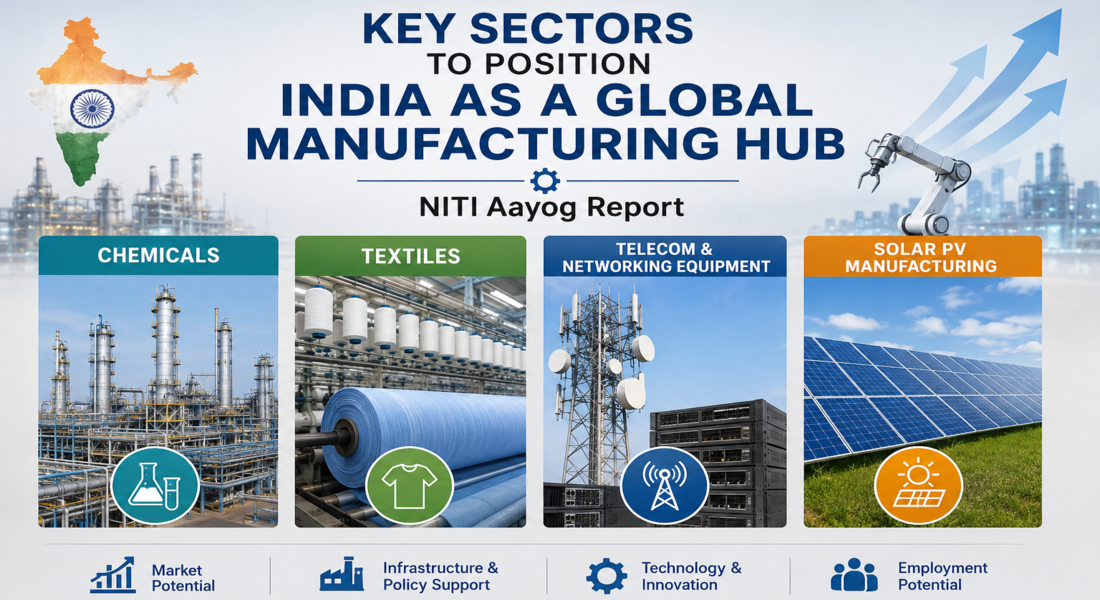

New Delhi: NITI Aayog has released a report titled “Key Sectors to Position India as a Global Manufacturing Hub.” The report identifies major sectors that could drive India’s ambition to become a global manufacturing powerhouse.
The study analysed four sectors in this edition. These include chemicals, textiles, telecom and networking equipment, and solar photovoltaic manufacturing. Reports on eight more sectors will follow in subsequent editions, according to an official statement.
The assessment examined India’s manufacturing landscape against global trends and benchmarks. It looked at market potential, infrastructure readiness, policy support, raw material availability, and technology readiness. Employment potential and India’s current position in the value chain were also considered.
The study was carried out in four phases. The first phase shortlisted sectors based on their growth potential in domestic and global markets. The second phase conducted a detailed assessment of market potential, competitiveness, and strategic relevance. The third phase benchmarked international best practices from top-performing countries. The fourth phase developed actionable, sector-specific recommendations and a roadmap forward.
Chemicals sector: The report noted that India’s chemicals industry is led by three segments: petrochemicals and organic chemicals, specialty chemicals, and inorganic chemicals. Petrochemicals and organic chemicals form the largest segment.
The report also said India has significant scope to boost domestic value addition by expanding downstream production and improving feedstock utilisation. It called for greater investment in competitiveness and strategic use of free trade agreements to cut import dependence.
Textiles sector: The textile and apparel industry contributes nearly 2% to India’s GDP and 11% to manufacturing GVA, the report said. It accounts for 9% of merchandise exports and is the second-largest employer after agriculture, supporting more than 45 million livelihoods.
India exported textile products worth USD 37.7 billion in fiscal 2025. This gave the country a 4.1% share of global textile and apparel exports, making it the sixth-largest textile exporter worldwide.
The report recommended improving raw material availability, scaling manufacturing infrastructure, and deepening trade integration. It also called for a push on technical textiles, man-made fibre products, and premium Indian weaves.
Telecom and networking equipment sector: India is currently the world’s second-largest telecom market, with over 1.2 billion subscribers and around 85% telecom penetration, the report said. Internet usage stands at nearly 75%.
The National Telecom Policy 2025 aims to double the sector’s GDP contribution and export earnings by 2030. It also targets creating one million new jobs and raising investment and R&D spending.
The report called for deeper localisation, stronger domestic component manufacturing, and more joint ventures and technology transfers in the sector.
Solar PV sector: India had installed 106 GW of solar capacity by March 2025, the report noted. The country needs to add about 174 GW more to hit its 2030 target of 280 GW.
The domestic solar PV market, valued at around Rs 32,400 crore, is projected to grow 17-20% annually between fiscal 2023 and fiscal 2030. The report cited technology partnerships, R&D support, and integrated clean-tech clusters as key priorities to reduce import dependence.
The report described itself as a guide for strengthening India’s manufacturing ecosystem over time, calling for coordinated efforts between industry and government.