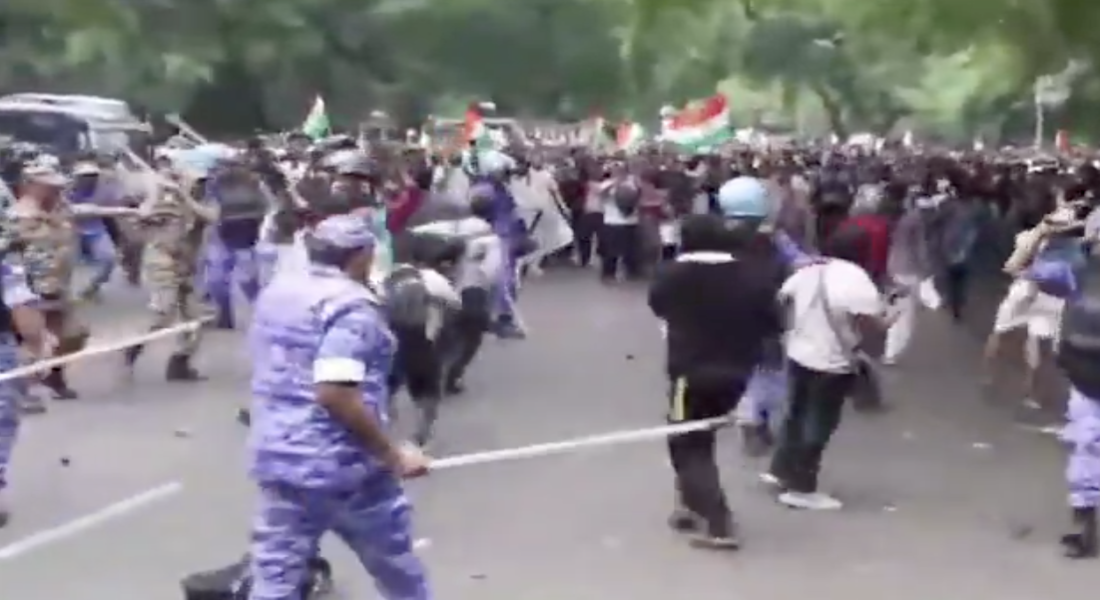

New Delhi: Police resorted to lathi-charge and fired tear gas shells on Monday to disperse thousands of students and youth activists participating in the Cockroach Janta Party’s (CJP) “Chalo Sansad” march, as protests demanding the resignation of Union Education Minister Dharmendra Pradhan over the alleged NEET-UG paper leak intensified in the national capital.
The protest, which coincided with the opening day of the Monsoon Session of Parliament, witnessed heavy deployment of security personnel as demonstrators attempted to march from Jantar Mantar towards Parliament despite prohibitory orders imposed by the Delhi Police. Protesters claimed that police used force to clear Jantar Mantar, while videos circulating on social media appeared to show police personnel baton-charging demonstrators, with several protesters sustaining injuries. Tear gas shells were also fired after protesters were stopped near Raisina Road, around 200 metres from Parliament.
The Delhi Police, however, denied allegations of excessive force. Deputy Commissioner of Police Sachin Sharma said no police personnel had used force against protesters, even as the situation became tense after the arrival of Azad Samaj Party (Kanshiram) chief Chandrashekhar Azad’s convoy. Police alleged that some protesters resorted to stone-pelting, leading to a brief escalation in tensions.
The CJP alleged that Delhi Police dragged activist Sonam Wangchuk’s wife, Gitanjali J. Angmo, by her hair while dispersing protesters. The organisation also claimed that internet services were disrupted around the protest site. These claims could not be independently verified.
The @DelhiPolice dragged Sonam Sir’s wife by hair out of the protest and continues to Lathi charge innocent protestors pic.twitter.com/ofWzkaWd4S
— Cockroach is Back (@Cockroachisback) July 20, 2026
Despite the police action, demonstrations continued across central Delhi, with protesters regrouping at multiple locations. While Delhi Police estimated the gathering at around 8,000 people, the CJP claimed the turnout had crossed one lakh. Several media reports also described the gathering as one of the largest student-led demonstrations in recent years.
Earlier in the day, the Centre initiated dialogue with the protest leaders. CJP spokespersons Saurav Das informed that he and Ashutosh Ranka met Union Health Minister J.P. Nadda at his residence for around 10 minutes after the government reached out to the organisation. During the meeting, the CJP reiterated its three principal demands: the immediate release of activist Sonam Wangchuk from Safdarjung Hospital, the resignation of Union Education Minister Dharmendra Pradhan, and compensation of ₹1 crore for the families of students who allegedly died by suicide following the NEET-UG paper leak controversy.
Following the meeting, Das said in a post on X that the minister had accepted the memorandum and assured the delegation that he would discuss the matter internally at the appropriate level. However, he clarified that no commitments had been made by the government and asserted that the peaceful protest would continue until the demands were addressed.
🚨#ImportantAnnouncement: @AshutoshRanka and I have been at J.P. Nadda’s residence since 12 noon. The demands have been conveyed, including immediate resignation/sacking of Dharmendra Pradhan.
— Saurav Das (@SauravDassss) July 20, 2026
The Minister assured us he will discuss this at the appropriate level. However, no… pic.twitter.com/vzLluczbkV
In a post on X, Minister J.P. Nadda wrote:“The meeting took place in a cordial atmosphere. An initial verbal discussion was held in detail with their delegation, and they submitted a written petition to me around 4 p.m.”
The CJP’s memorandum accused the Education Minister of being directly responsible for repeated examination-related controversies, including the alleged NEET-UG paper leak, and criticised the government for failing to implement systemic reforms in the education sector.
The protest march drew support from leaders across the political spectrum and members of the cultural community. Azad Samaj Party chief Chandrashekhar Azad, Trinamool Congress MP Mahua Moitra, actors Prakash Raj and Shabana Azmi, and several leaders of the Aam Aadmi Party visited the protest site to express solidarity with the demonstrators.
AAP leader Atishi condemned the police action, saying the lathi-charge and firing of tear gas shells on students demanding the Education Minister’s resignation was “extremely cruel” and alleging that such actions reflected the government’s intolerance towards peaceful protests.
Meanwhile, activist Sonam Wangchuk remained admitted to Safdarjung Hospital after being shifted there by Delhi Police on July 18 following a deterioration in his health during his indefinite hunger strike. In a handwritten letter released from the hospital, Wangchuk reiterated that he would end his fast only if the government accepted accountability for alleged failures in the education system or Members of Parliament assured him that the issue would be taken up during the Monsoon Session. He has continued to describe his hospitalisation as “illegal detention”.
Delhi Police had earlier denied permission for the Parliament march and imposed prohibitory orders under Section 163 of the Bharatiya Nagarik Suraksha Sanhita (BNSS), maintaining that no authorisation had been granted for the procession. Security remained tight across central Delhi throughout the day, with barricades, riot-control vehicles and a heavy police presence deployed around Jantar Mantar and key routes leading to Parliament.