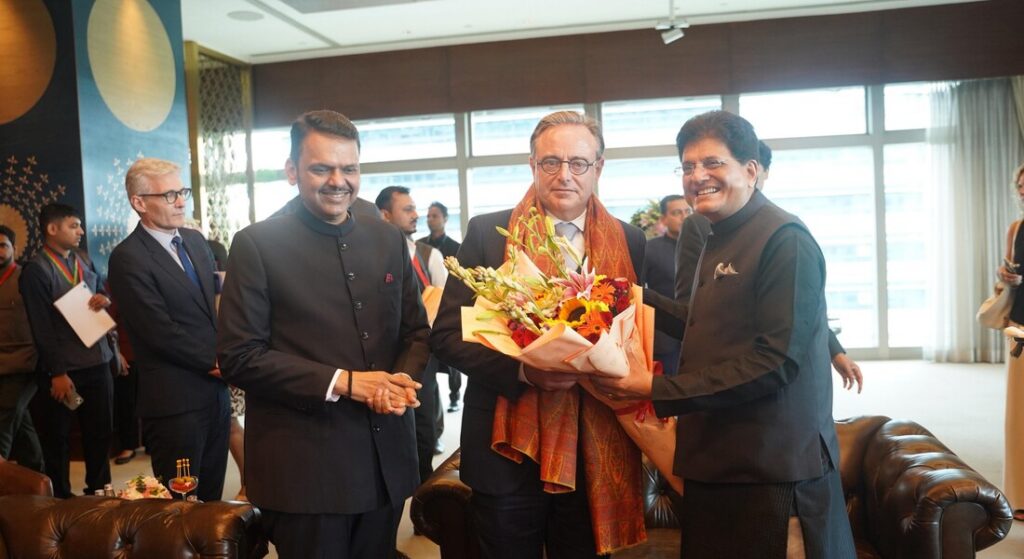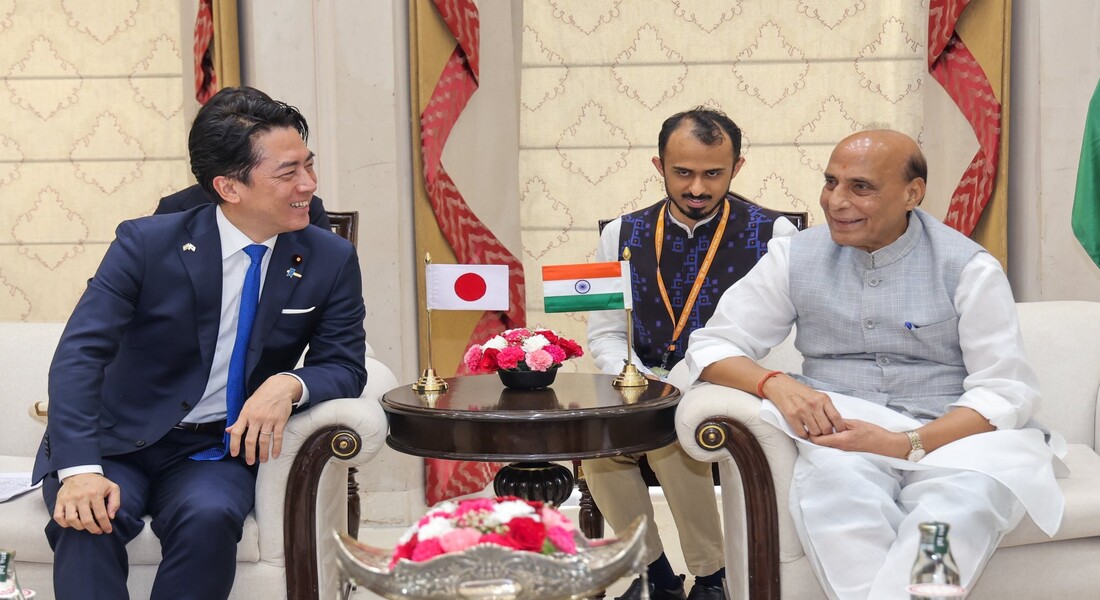

New Delhi: Defence Minister Rajnath Singh held bilateral talks with Japanese Defence Minister Shinjiro Koizumi in New Delhi on Thursday. The two ministers signed a Memorandum of Arrangement on Maritime Security Cooperation between the two countries.
The two sides said their defence cooperation had steadily strengthened under the Japan-India Special Strategic and Global Partnership. They noted this partnership remained a key pillar for peace and stability in the Indo-Pacific region, according to an official statement.
Recalling the joint statement issued by the two countries’ leaders in July 2026, the ministers reaffirmed their commitment to deepening defence ties to secure a free and open Indo-Pacific. They agreed on the importance of sharing assessments of the regional security environment amid rising global tensions.
Both ministers opposed unilateral actions that threaten freedom of navigation and overflight, as well as any attempt to change the status quo through force or coercion.
The newly signed maritime security memorandum will strengthen cooperation between the Indian Navy and the Japan Maritime Self-Defense Force. Officials said the arrangement covers information sharing on maritime domain awareness, along with expanded cooperation in search and rescue and humanitarian assistance operations. The two sides agreed to strengthen coordination for protecting sea lines of communication through naval ship visits, joint exercises, and logistical support.
The ministers agreed to move quickly on concrete maritime security cooperation. They also decided to explore joint development in naval shipbuilding, combining Japan’s technological expertise with India’s production capacity under the Make in India framework. Both sides agreed to progress on reciprocal ship repair arrangements.
The two countries welcomed the continued expansion of joint military exercises, including the Army exercise Dharma Guardian and the naval exercise JAIMEX. They highlighted progress on Veer Guardian 26, the upcoming Japan-India air force exercise, under which Japanese fighter jets will visit India for the first time.
The ministers agreed to deepen exercise cooperation by adding complexity, integrating unmanned systems, and holding joint drills at short notice when opportunities arise.
Singh welcomed Japan’s recent revision of its defence equipment and technology transfer framework. He said he expected Japan to further contribute to peace and stability across the Indo-Pacific and beyond, and voiced hope for deeper defence-technology cooperation between the two nations.
Both ministers described the shipborne UNICORN integrated communications antenna system project as a symbol of growing defence-technology cooperation, calling it the first such equipment transfer between the two countries.
They committed to working toward its early implementation. They also agreed to deepen defence research cooperation between India’s DRDO and Japan’s ATLA on advanced defence technologies, and confirmed plans to convene a Defence Industry Forum.
The two sides welcomed the first trilateral naval exercise involving India, Japan and Indonesia, held in February this year. They agreed to deepen cooperation with third countries through high-level exchanges and joint exercises to support peace and stability across the Indo-Pacific.
The ministers also agreed to expand cooperation under the Indo-Pacific Logistics Network to support partner nations during natural disasters. They noted the network’s second tabletop exercise is scheduled for September in Japan.
The two sides agreed to accelerate discussions toward holding the fourth India-Japan Foreign and Defence Ministerial or “2+2” dialogue in Tokyo this year. They further agreed to hold consultations as needed to ensure security and regional stability, and decided to set up a working group at the Director-General/Joint Secretary level to coordinate cooperation across operational, intelligence, equipment, technology and industrial domains.
Before the meeting, Koizumi paid tribute to India’s fallen soldiers at the National War Memorial in New Delhi, where he received a ceremonial Tri-Service Guard of Honour. He also visited the Western Naval Command in Mumbai and the Indian Naval Ship Chennai.