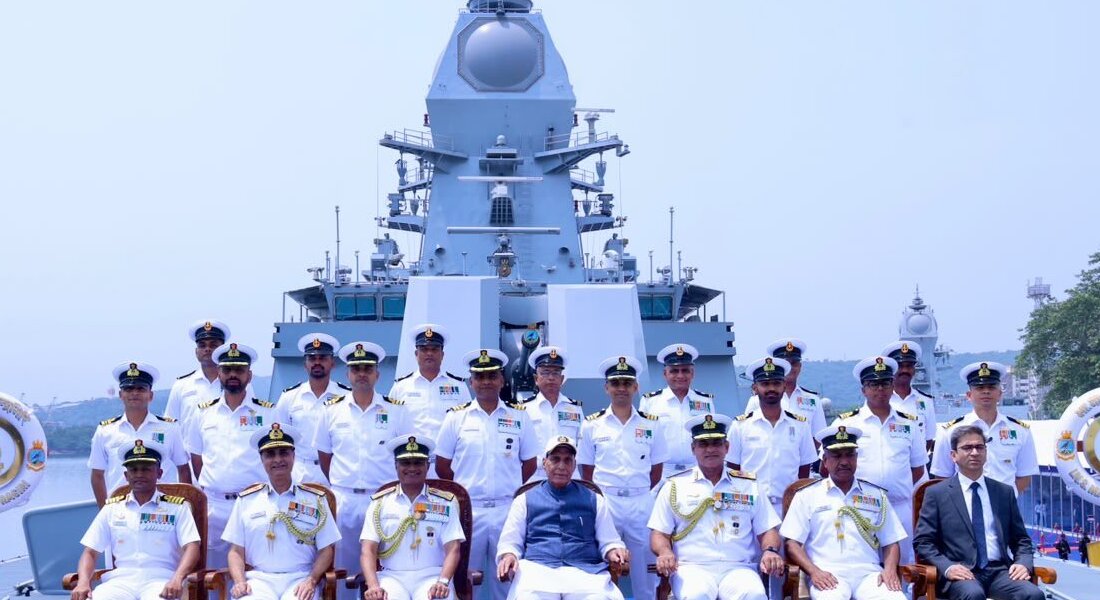

New Delhi: The Indian Navy on Saturday inducted the indigenously built stealth frigate INS Mahendragiri into its Eastern Fleet, marking another milestone in India’s drive for self-reliance in defence manufacturing.
The frontline warship was inducted during a ceremony attended by Defence Minister Rajnath Singh, who said the vessel reflects India’s growing capabilities in indigenous warship design, shipbuilding and defence production.
INS Mahendragiri is the sixth Project 17A stealth frigate to join the Indian Navy in just 18 months. It follows the induction of INS Nilgiri, INS Udaygiri, INS Himgiri, INS Taragiri, and INS Dunagiri. The warship was designed by the Navy’s Warship Design Bureau and built by Mazagon Dock Shipbuilders Limited in Mumbai, according to an official statement.
With more than 75% indigenous content, the 6,670-tonne warship can achieve speeds of up to 28 knots. It is designed to undertake a wide range of operations, including fleet air defence, anti-surface warfare, anti-submarine warfare, maritime interdiction, surveillance, and humanitarian assistance and disaster relief.
The frigate is equipped with advanced stealth features, modern sensors, network-centric combat systems, and state-of-the-art weapon systems. It can be armed with BrahMos supersonic surface-to-surface missiles, medium-range surface-to-air missiles, torpedo launchers, an Integrated Anti-Submarine Defence System, an electronic warfare suite, a close-in weapon system, and a multi-role helicopter.
Addressing the ceremony, Rajnath said the warship would strengthen India’s maritime security and safeguard the country’s interests not only along its coastline but also across the deep oceans. He described INS Mahendragiri as a symbol of India’s commitment to building a technologically advanced and combat-ready Navy.
The defence minister further said emerging technologies such as artificial intelligence, drones, cyber warfare, hypersonic weapons, unmanned systems and space-based capabilities are changing the nature of warfare. However, he stressed that conventional military strength remains the foundation of national defence, saying future wars may involve artificial intelligence.
He said the government is pursuing a balanced approach by investing in next-generation technologies while continuing to strengthen conventional defence capabilities. Referring to Operation Sindoor, he said it demonstrated the effective integration of conventional and modern military capabilities to safeguard national security.
Highlighting the strategic importance of the Indo-Pacific, Rajnath Singh reaffirmed the government’s commitment to the vision of Security and Growth for All in the Region. He said India remains a trusted security partner and net security provider in the region, with the Indian Navy playing a key role in humanitarian assistance, anti-piracy operations and evacuation missions.
Referring to the recent West Asia conflict, the minister said that under Operation Urja Suraksha, the Indian Navy safely escorted 18 merchant vessels carrying essential cargo worth over Rs 9,000 crore, protecting the country’s economic interests.