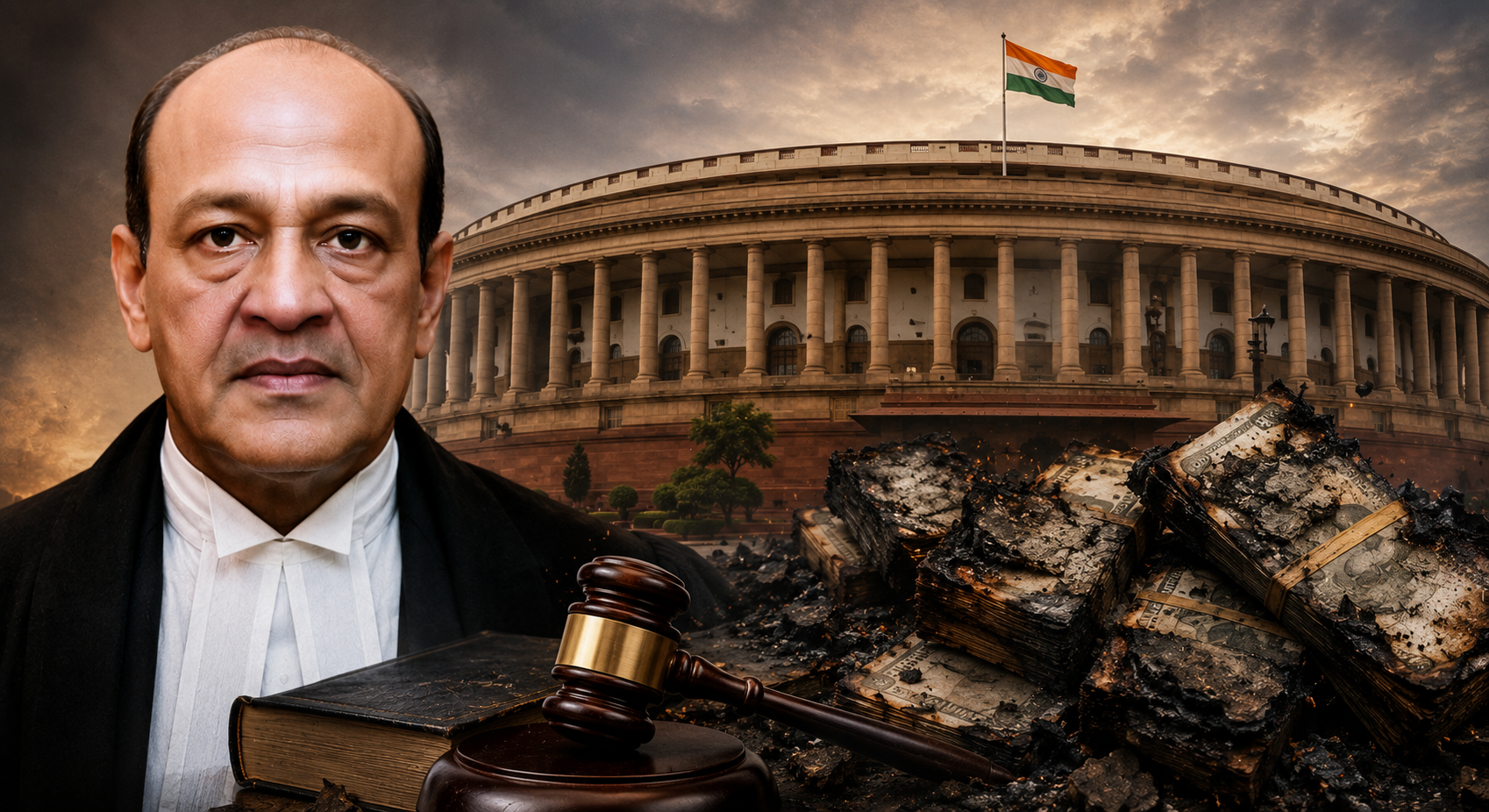

New Delhi: A three-member inquiry committee has found all three charges against former Delhi High Court judge Justice Yashwant Varma proved in connection with the discovery of a substantial quantity of unexplained cash at his official residence in Delhi.
The committee, constituted by Lok Sabha Speaker Om Birla under the Judges (Inquiry) Act, 1968, concluded that substantial cash in Rs 500 denomination was found in a storeroom at Varma’s official residence at 30 Tughlak Crescent after a fire on March 14, 2025. It also found that material evidence relating to the incident was not properly preserved and that Varma’s explanations about the cash, its source and ownership were inadequate.
The committee, whose report was tabled in the Lok Sabha today, examined three charges framed against Varma. However, the findings did not establish in criminal-law terms that the cash personally belonged to him. Instead, the panel concluded that substantial unexplained cash was found on premises under his control and that he failed to satisfactorily explain its presence, source or ownership.
One of the charges concerned the cash found in the storeroom following the fire. The panel found that the evidence indicated the presence of bundles, heaps and stacks of currency rather than a small quantity of loose notes. It rejected Varma’s contention that the storeroom was completely outside his control, holding that it formed part of his official residential premises and remained under his institutional control.
The exact amount of cash could not be established. According to the findings, the money was never formally seized, counted, inventoried or preserved at the site. The committee therefore concluded that a substantial quantity of Rs 500 notes had been present but could not determine the precise value.
The second charge related to the handling of the site after the fire. The committee found that the storeroom was not immediately sealed and that cleaning took place after first responders had left. By the time a formal inspection was conducted, the cash was no longer available.
The panel referred to the presence of Justice Varma’s Private Secretary Rajinder Singh Karki and household staff member Mohd Rahil near the storeroom during the cleaning. However, it did not conclude that Varma himself had removed the cash.
The third charge concerned Varma’s explanations regarding the incident. The committee found his responses inadequate and said they did not satisfactorily address questions concerning the presence, source and ownership of the cash, as well as the actions taken after the fire. The panel described the explanations as “evasive, incomplete and misleading in effect” and said they fell short of the level of candour and institutional responsibility expected in the circumstances.
Justice Varma denied the allegations and maintained that no cash had been recovered from his residence. He argued that he was not present when the fire broke out and was not among the first responders. His defence also raised possibilities including conspiracy, planting of currency, fake notes and removal of money by first responders.
The committee said these claims were not supported by defence evidence. It noted that no defence witnesses or affidavits had been submitted and rejected the argument that the storeroom was entirely outside Varma’s control. Varma subsequently withdrew from further participation in the proceedings after the presenting side completed its evidence and cross-examination.
The controversy began on March 14, 2025, when a fire broke out at Varma’s official residence. Cash was reportedly found during firefighting operations, triggering a major controversy and an in-house inquiry ordered by then Chief Justice of India Sanjiv Khanna. Varma was subsequently transferred from the Delhi High Court to the Allahabad High Court and his judicial work was withdrawn pending the inquiry.
The parliamentary inquiry was constituted in September 2025 after the Lok Sabha Speaker admitted a motion seeking Varma’s removal. The committee held its first meeting on September 17 and framed the charges on November 26. Varma challenged the constitution of the committee, but the Supreme Court dismissed his challenge on January 16, 2026.
The committee’s findings are relevant to the parliamentary process for removal of a judge and do not by themselves constitute a criminal conviction. Its conclusion was that all three charges framed against Varma were proved.
Varma, meanwhile, resigned as a judge of the Allahabad High Court while facing the prospect of removal by Parliament. His resignation rendered the removal proceedings infructuous, according to the report.
The inquiry findings therefore establish the committee’s conclusions for the purposes of the parliamentary process, while leaving the question of criminal liability separate from the committee’s determination.