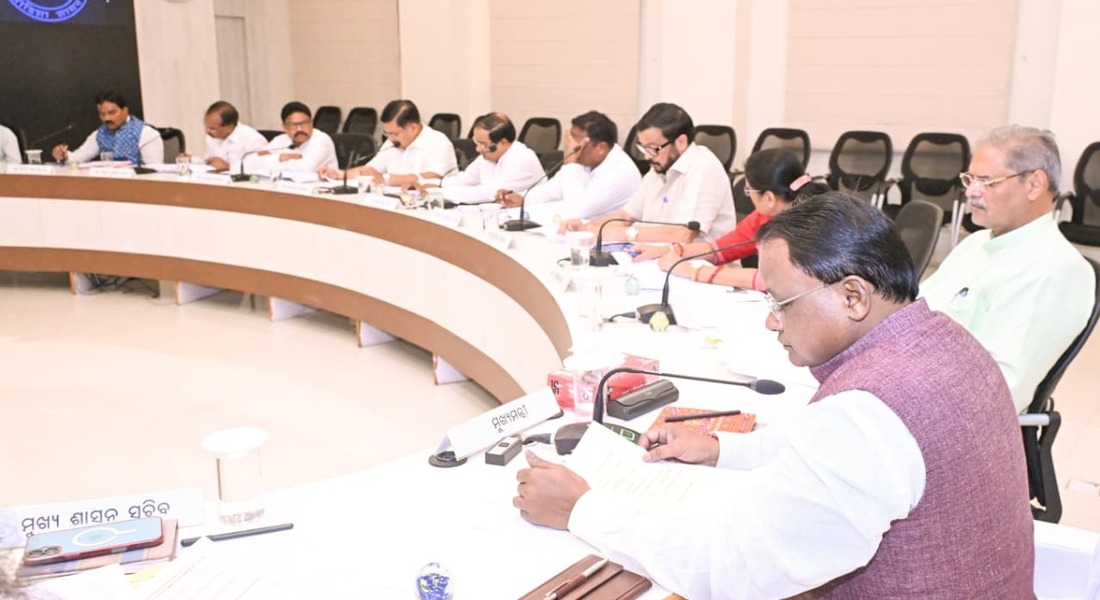

Bhubaneswar: The Odisha Cabinet today approved a series of measures covering irrigation, renewable energy storage, child welfare, early childhood care and compassionate appointments in government service. Among the key decisions are the ₹12,458.04-crore Parbati Giri Mega Lift Irrigation Project, amendments to the Odisha Pumped Storage Projects (PSP) Policy, 2025, and the revival of 680 minor irrigation projects across the state.
The Cabinet approved the amended Odisha PSP Policy, 2025 and Operational Guidelines, which will remain in force until March 31, 2030. The policy seeks to promote pumped storage projects as a long-duration energy storage option to support the increasing share of renewable energy. Pumped storage projects can store surplus electricity during off-peak periods and release it during periods of high demand or low renewable energy availability.
The amended policy provides a range of incentives, including infrastructure support, exemption from electricity duty, cross-subsidy surcharge, wheeling charges and STU charges, along with exemption from water cess, provision of free power and benefits under the Local Area Development Fund. Odisha has set a target of adding around 11,000 MW of renewable energy capacity by 2030.
In irrigation, the Cabinet approved the Parbati Giri Mega Lift Irrigation Project with an outlay of ₹12,458.04 crore, to be implemented over five years from FY 2026-27 to FY 2030-31 using state resources. The project will comprise 161 schemes across all districts and is expected to create an additional irrigation potential of 2,62,275 hectares.
The project will use pressurised underground pipeline distribution systems compatible with micro-irrigation technologies. According to the government, the initiative is intended to improve water-use efficiency, reduce dependence on rainfall, facilitate multiple cropping and encourage farmers to diversify towards high-value cash crops.
The Cabinet also approved Improvement to Tanks & MIPs – Phase-III, with an outlay of ₹389 crore over four years from FY 2026-27 to FY 2029-30. The scheme will cover 680 Minor Irrigation Projects, including spillover works from Phase-II, and aims to revive irrigation potential over approximately 15,700 hectares. Works will include desilting reservoirs, strengthening embankments, repairing spillways and head regulators, and improving canals.
In the social welfare sector, the Cabinet approved continuation of the Jashoda scheme and its sub-scheme Ashirbad for another five years, from FY 2026-27 to FY 2030-31, with a total budget of ₹296.99 crore. The schemes provide financial, educational and social support to vulnerable children, including those without biological parents, those with incapacitated parents, children affected or infected by HIV, and children who lost their primary breadwinner during the COVID-19 pandemic.
The Cabinet also approved continuation of the Malati Devi Prak Vidyalaya Paridhan Yojana for five years, with a total outlay of ₹586.51 crore. The scheme will benefit around 14.76 lakh preschool children aged three to six years annually. Revised provisions include two pairs of uniforms, one pair of shoes, two pairs of socks and a sweater for each beneficiary, with different unit costs for boys’ and girls’ uniforms.
Finally, the Cabinet approved the Odisha Civil Services (Rehabilitation Assistance) Rules, 2026, replacing the 2020 rules. The revised framework abolishes the 100-point evaluation system, removes the 50% ceiling on filling base-level Group-D posts through the Rehabilitation Assistance Scheme, and provides for nomination of another eligible family member in specified circumstances. Pending cases, including those rejected solely under the earlier 100-point evaluation system, will also be considered under the new rules.