
New Delhi: A detailed analysis of self-sworn affidavits filed by all 126 winning candidates in the 2026 Assam Assembly Elections, conducted by the Association for Democratic Reforms (ADR) and Assam Election Watch, reveals a mixed picture – a modest decline in the proportion of legislators with criminal backgrounds, but a significant and accelerating rise in personal wealth among elected representatives.
Criminal Cases: A Decline, But Concern Remains
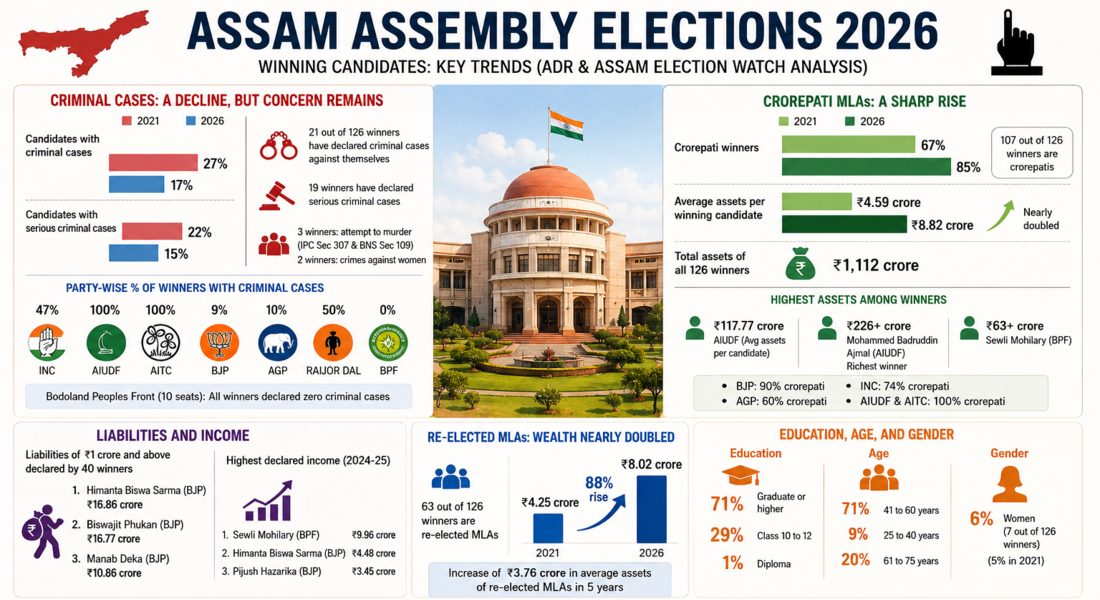
The proportion of winning candidates with declared criminal cases has fallen from 27% in 2021 to 17% in 2026, with 21 out of 126 winners having declared cases against themselves. Similarly, those with serious criminal cases dropped from 22% to 15%, with 19 winners falling in this category. While the trend is encouraging, the persistence of candidates with grave charges remains a matter of concern. Three winning candidates have declared cases related to attempt to murder under IPC Section 307 and BNS Section 109, while two have declared cases related to crimes against women, the ADR said in a press release.
A party-wise breakdown reveals stark disparities. The Indian National Congress recorded the highest proportion of winners with criminal cases at 47%, with nine out of 19 winning candidates carrying such declarations. Both winning candidates from the AIUDF and the sole winner from the AITC declared criminal cases, representing a 100% rate for each party.
The BJP, despite being the dominant force with 82 seats, recorded a comparatively lower rate of nine percent, with seven winners declaring criminal cases. The Asom Gana Parishad recorded a 10% rate, while Raijor Dal stood at 50%. Notably, the Bodoland Peoples Front, which won 10 seats, emerged with a clean slate – all its winning candidates declared zero criminal cases.
Crorepati MLAs: A Sharp Rise
The proportion of crorepati winners has jumped significantly, rising from 67% in 2021 to 85% in 2026, with 107 out of 126 winning candidates declaring assets exceeding one crore rupees. The average assets per winning candidate have nearly doubled, climbing from Rs 4.59 crore in 2021 to Rs 8.82 crore in 2026. The combined declared assets of all 126 winners stand at Rs 1,112 crore.
Among parties, the AIUDF’s two winners declared the highest average assets at Rs 117.77 crore per candidate, driven significantly by party chief Mohammed Badruddin Ajmal, whose total declared assets amount to over Rs 226 crore, making him the wealthiest among all winning candidates. Sewli Mohilary of the Bodoland Peoples Front follows with assets exceeding Rs 63 crore, while Chief Minister Himanta Biswa Sarma of the BJP declared assets of over Rs 35 crore.
Both Raijor Dal winners are crorepatis, as are all winning candidates from the AIUDF and AITC. The BJP recorded a 90% crorepati rate among its winners, while the INC stood at 74% and the Asom Gana Parishad at 60%.
Liabilities and Income
Forty winning candidates declared liabilities of one crore and above. Chief Minister Himanta Biswa Sarma tops the liabilities list with declared liabilities of over Rs 16.86 crore against total assets of Rs 35.16 crore. He is followed by BJP’s Biswajit Phukan with liabilities of Rs 16.77 crore and Manab Deka with liabilities of Rs 10.86 crore.
On declared income, Sewli Mohilary of the Bodoland Peoples Front recorded the highest income at over Rs 9.96 crore for 2024-25, followed by Himanta Biswa Sarma at Rs 4.48 crore and BJP’s Pijush Hazarika at Rs 3.45 crore.
Re-Elected MLAs: Wealth Nearly Doubled
Of the 126 winners, 63 are re-elected MLAs. Their average assets have grown from Rs 4.25 crore in 2021 to Rs 8.02 crore in 2026 – an increase of Rs 3.76 crore, representing an 88% rise in five years. This sharp appreciation in declared wealth among sitting legislators is likely to draw further scrutiny from electoral watchdogs and civil society organisations.
Education, Age, and Gender
On education, 71% of winning candidates hold graduate or higher qualifications, while 29% have declared educational attainment between Class 10 and Class 12. One winner holds a diploma.
The majority of winners, 71%, fall in the 41 to 60 age bracket, while nine percent are between 25 and 40 years old, and 20% are between 61 and 75 years of age. On gender representation, women account for just seven of the 126 winning candidates, or six percent – a marginal improvement from five percent, or six winners, in 2021. The figure underscores the continued and deep underrepresentation of women in Assam’s legislative assembly.
While the 2026 Assam election results reflect a modest improvement in the criminal profile of elected representatives compared to 2021, the data present a more troubling picture on economic grounds. The near-doubling of average assets, the sharp rise in crorepati legislators, and the significant wealth accumulation among re-elected MLAs raise important questions about the growing economic distance between elected representatives and the constituents they serve.