
Bhubaneswar: The Odisha government, through the Comprehensive Regional Urban Transport (CRUT), has proposed piloting a Bus Priority Lane initiative on two key corridors in Bhubaneswar, a major step towards improving urban mobility and strengthening public transport in the city.
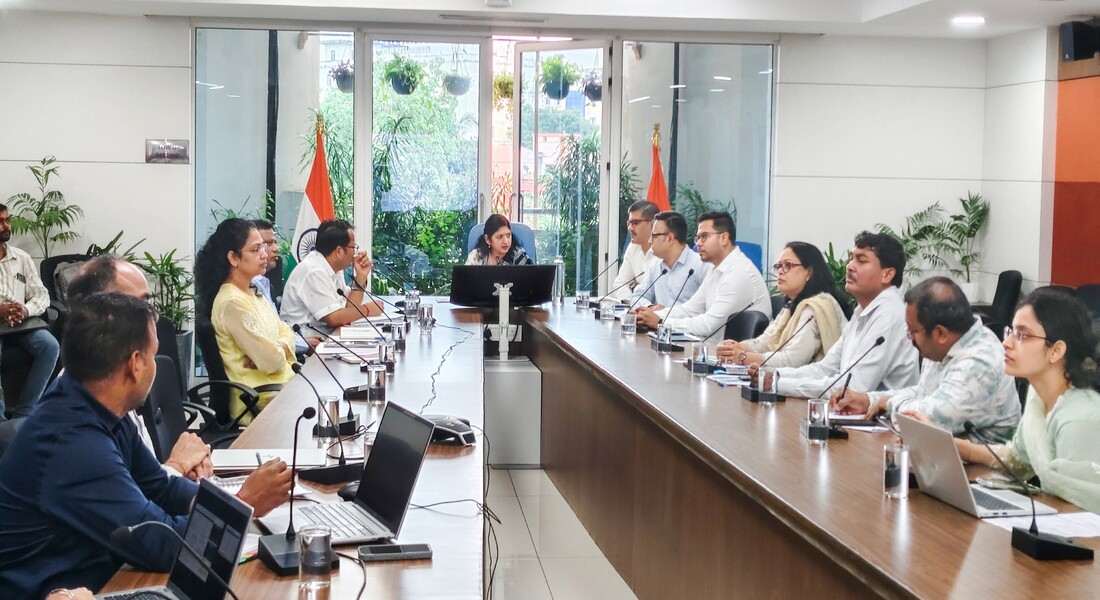
The decision was taken at a high-level meeting chaired by Additional Chief Secretary, Housing & Urban Development Department, Usha Padhee, at Kharavela Bhawan, Bhubaneswar.
Transport Commissioner Amitabh Thakur, CRUT Managing Director Md, attended the meeting. Siddique Alam, Bhubaneswar Municipal Corporation (BMC) Commissioner Chanchal Rana, Additional DCP (Traffic), and officials from the Chief Construction Engineer’s office, R&B, Works Department, Bhubaneswar Development Authority and BMC.
Following a detailed presentation by Md. Siddique Alam, the Additional Chief Secretary directed that the initiative be taken up initially on a pilot basis along two high-density corridors.
A multi-agency committee has been constituted to oversee implementation, monitor the pilot on a continuous basis, and make necessary refinements before finalising the model for wider expansion.
The Bus Priority Lane initiative seeks to address traffic congestion, improve the reliability and predictability of public transport, and make more efficient use of available road space by giving priority to public buses, school buses and emergency or essential services.
Congestion in mixed traffic currently results in an estimated loss of 1,200–1,500 bus trips every month, accounting for nearly 16 per cent trip loss due to traffic-related cancellations, besides causing significant variations in bus travel time.
By reallocating appropriate kerb-side road space for priority movement, the pilot is expected to achieve a 10–20 per cent reduction in bus travel time and a 15–25 per cent improvement in average bus speeds, along with improved road safety.
The two corridors identified by CRUT in coordination with Traffic Police and the Works Department are the Biju Patnaik International Airport–Nandankanan Corridor, covering 18 km, and the Vani Vihar–Sishu Bhawan Corridor, covering 5 km.
The Airport–Nandankanan corridor connects major administrative, educational, commercial, and healthcare destinations, covers 34 bus stops, and caters to an average daily ridership of around 9,000–10,000 passengers across major routes.
The Vani Vihar–Sishu Bhawan corridor traverses important commercial and transit locations, including Master Canteen, Rajmahal, Ram Mandir and the Bhubaneswar Railway Station area, covering 15 bus stops and catering to approximately 5,000–6,500 passengers daily.
The pilot will adopt a flexible kerb-side bus priority lane design rather than rigid physical segregation, aiming to minimise disruption to general traffic while improving bus movement and operational efficiency.
The preparatory phase, expected to take around 10–12 weeks, will include detailed traffic surveys, corridor-level design, lane markings, signage, improvement of Bus Queue Shelters, traffic signal optimisation, and identification of designated pick-up and drop-off points for three-wheelers and cabs. This will be followed by a 3–6 month pilot phase, during which operational performance will be closely monitored and real-time data collected through Intelligent Transportation Management Systems.
The multi-agency committee will also prepare detailed Standard Operating Procedures for operationalisation of the Bus Priority Lane, defining lane usage, bus movement protocols, stopping and boarding arrangements, interaction with other road users, enforcement mechanisms, emergency access, incident management and the responsibilities of concerned agencies.
These SOPs will be finalised based on operational requirements identified during the preparatory phase and refined further based on experience gained during the pilot.
A key component of the initiative will be training and sensitisation of CRUT bus crew. Drivers and other operational staff will receive dedicated training on the Bus Priority Lane system, covering lane discipline, entry and exit protocols, safe stopping at designated locations, interaction with general traffic, pedestrian safety, emergencies, and compliance with the approved SOPs. CRUT will conduct this training before the commencement of the pilot to ensure safe and consistent operations.
The initiative will be supported by round-the-clock ITMS-based monitoring and Automatic Number Plate Recognition CCTV cameras, along with on-ground enforcement by Traffic Police personnel. The in-bus camera system installed in public buses will also be explored as a technology-enabled enforcement and monitoring tool, with camera feeds and recorded footage assisting in identifying unauthorised use of the priority lane, unsafe lane changes, obstruction, illegal parking and other violations, subject to applicable protocols and technical feasibility.
Unauthorised entry of private vehicles into the priority lanes and illegal kerbside parking will attract auto-generated e-challans wherever technically and legally feasible, while emergency services, including ambulances and fire tenders, will have unrestricted priority access to the designated lanes.
Extensive public awareness and sensitisation measures will be undertaken before implementation. Road users, public transport users, residents, commercial establishments, schools and other stakeholders along the identified corridors will be informed about the proposed changes, lane markings, permitted users, traffic movement arrangements and enforcement provisions through signage, social media, media campaigns, on-road information boards and other channels, to facilitate a smooth transition and encourage voluntary compliance.
The initiative will also be aligned with a broader Hub-and-Spoke or Trunk-and-Feeder public transport model for Bhubaneswar.
Suitable feeder routes will be identified based on passenger demand and corridor-level travel patterns and integrated with major trunk routes and transport hubs, strengthening first- and last-mile connectivity, improving access to high-capacity public transport corridors, and reducing dependence on private vehicles for short connecting trips.