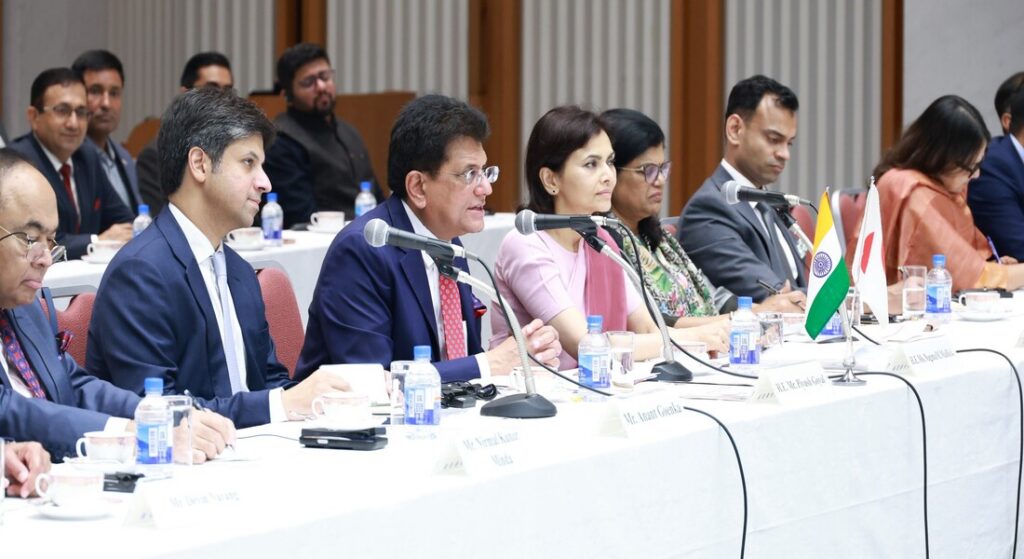
New Delhi: Defence Minister Rajnath Singh on Monday chaired the fifth meeting of the Informal Group of Ministers (IGoM) on West Asia in New Delhi, where the Centre reviewed the impact of the ongoing regional conflict and outlined measures aimed at protecting India’s economy, fuel security, and supply chains from global disruptions.
The high-level meeting focused on India’s preparedness amid prolonged geopolitical tensions in West Asia, with the government asserting that the country currently faces no shortage of petroleum products or essential commodities despite sharp volatility in international energy markets.
According to officials briefed during the meeting, India presently maintains crude oil reserves sufficient for around 60 days, natural gas reserves for another 60 days, and LPG stock for nearly 45 days. The government also highlighted that India’s foreign exchange reserves remain strong at approximately USD 703 billion, according to an official statement.
The Centre noted that India continues to meet domestic fuel demand in full while also maintaining its position as one of the world’s largest oil refiners and exporters of petroleum products. Officials informed the ministers that Indian petroleum products are currently being exported to more than 150 countries.
However, the government acknowledged that rising international crude oil prices are placing a substantial financial burden on the country. Officials said Indian oil marketing companies have absorbed significant losses in recent months to shield consumers from global price shocks, with daily under-recoveries reportedly nearing Rs 1,000 crore.
Despite global fuel inflation triggered by the conflict, the government maintained that retail petroleum prices in India have remained largely stable over the past several weeks, unlike several other countries that have witnessed sharp increases in fuel costs.
The meeting also reviewed Prime Minister Narendra Modi’s recent appeal urging citizens to adopt fuel conservation measures and reduce unnecessary consumption during the period of international uncertainty.
As part of the proposed nationwide conservation effort, Modi had encouraged citizens to rely more on public transport systems such as metros, adopt carpooling, avoid unnecessary foreign travel, and prioritise domestic tourism. Citizens were also advised to reduce non-essential gold purchases to help conserve foreign exchange reserves.
The Centre additionally highlighted measures aimed at the agriculture sector, including reducing chemical fertiliser consumption, promoting natural farming practices, and encouraging the use of solar-powered irrigation pumps as alternatives to diesel-powered systems.
During the meeting, the defence minister directed ministries and state governments to work in coordination to institutionalise fuel efficiency measures, strengthen public awareness campaigns, and promote responsible consumption practices across sectors.
The government also stressed that there was no reason for public panic or panic-buying of fuel and essential commodities, stating that supply management systems remain stable and adequate stocks are available across the country.
Apart from Rajnath Singh, the meeting was attended by Union ministers J. P. Nadda, Hardeep Singh Puri, Ashwini Vaishnaw, Kiren Rijiju, Kinjarapu Ram Mohan Naidu, Sarbananda Sonowal, and Jitendra Singh.
Following the meeting, Rajnath Singh said the government was continuously monitoring the situation and taking necessary steps to prevent any disruption in the supply of essential commodities across the country.